


tl;dr
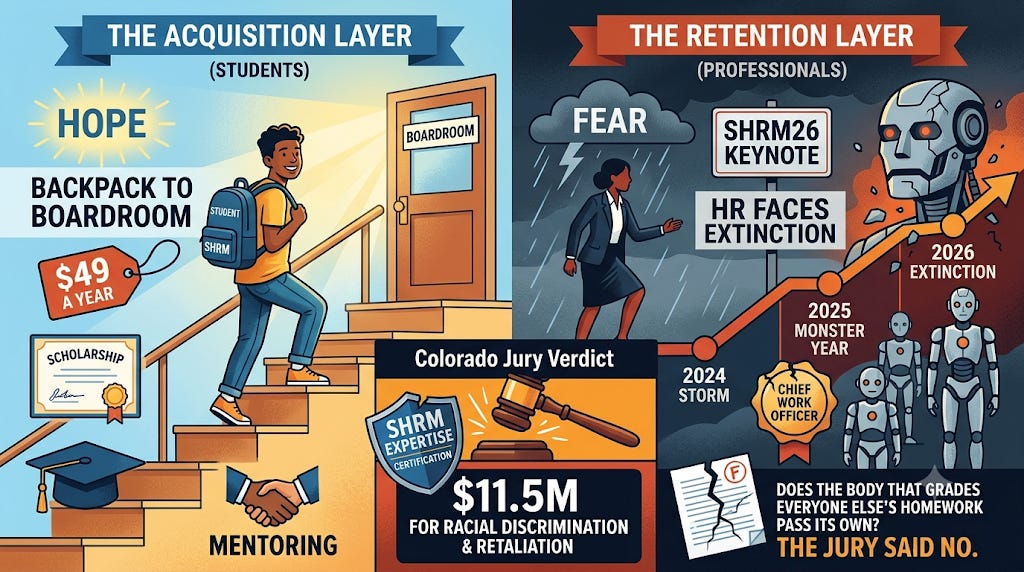
SHRM still sells hope to students (”backpack to boardroom,” $49 a year) and sells fear to the professionals who already paid in (the June SHRM26 keynote: HR faces “extinction”).
The hope is the acquisition layer. The fear is the retention layer. Which one you get depends on whether your dues have cleared.
In December a Colorado jury hit SHRM with $11.5M for racial discrimination and retaliation, and the judge let them weigh SHRM against the very expertise it sells. The court refused a retrial this spring. SHRM is appealing.
I had a concession ready in June: tell the kid to join anyway, the scholarships are real. I’ve spent two months unable to write that sentence.
Years ago, at Temple’s Fox School of Business, SHRM was the cool kids club.
I’m not being cute about it. If you were in the business school and you so much as looked sideways at HR, SHRM was where the serious people were. The chapter had a vibe. The badge meant something. It meant you weren’t just taking a class, you were joining a profession. It meant arrival.
I wanted in. So I got in.
Then I graduated, got busy, got broke, and let it lapse. I drifted first. This was never going to be a story about SHRM leaving me.
Here’s what dragged me back to it. In June, at SHRM26 in Orlando, Johnny Taylor took the main stage in front of video walls full of humanoid robots and told twenty thousand HR professionals that their profession had “lost the plot” and was staring down extinction. The fix, per the keynote, was to rebrand yourself a “Chief Work Officer” and start conducting the robots before they conduct you.
And it occurred to me that I had no idea what SHRM even sells anymore. So I went and looked.
It sells two completely different things. Which one you get depends entirely on whether you’ve paid.
To the professionals in that ballroom, it sells dread. And not for the first time. 2024 was “a storm is coming for HR.” 2025 was “another monster year,” the storm now officially here. 2026 is extinction. Three years of the same escalating weather report from the same stage. If your product is HR’s anxiety, business is booming.
To the kid I used to be, it still sells hope. Aggressively. More than when I was at Fox. There’s a slogan now, “backpack to boardroom.” Student membership runs forty-nine bucks, pitched as an investment in your future. There’s a discounted two-year runway to walk you from student into full paying dues, and schools can bulk-buy memberships ten students at a time. Four hundred grand in scholarships. A mentoring cohort.
Sit with that split for a second. The eighteen-year-old gets arrival. The forty-eight-year-old gets survival. Same organization, same summer, opposite emotions, sorted by tenure.
That’s the actual business. Hope is how they get you in the door. Fear is how they keep you paying once you’re inside. The cool kids club I remember didn’t disappear. It moved to the front of the funnel, where the new customers are.
I could have published a version of that in June. I nearly did.
Then I sat with the other thing.
In December, a Colorado jury found SHRM liable for racial discrimination and retaliation against a former employee named Rehab Mohamed, and set the number at eleven and a half million dollars. Ten of that was punitive, which is a jury’s way of saying this was not a close call. This spring the court refused to give SHRM a do-over. They’re appealing.
Read the details and it gets worse. The internal investigation was run by someone who, by his own testimony, had never conducted a workplace discrimination investigation before. One training session. The organization that sells the certification, the toolkit, the webinar, and the breakout session on how to handle exactly this could not handle exactly this.
And the judge let the jury weigh SHRM against its own reputation. The court ruled SHRM’s standing as the authority on HR could not “reasonably be excluded” from the case. So a jury got to ask the question out loud: does the body that grades everyone else’s homework pass its own? It said no, eleven and a half million times.
Here’s the part that reframed the keynote for me. That verdict landed in December. The retrial was denied in the spring. So when Taylor stood in Orlando in June and told a room full of practitioners they had lost the plot, the house he was speaking from had already been told, by a federal jury, that it had lost it worse.
Now the concession, because a piece like this owes you one.
The scholarships are real money. The mentoring is real. The local chapters and the volunteers who run them are some of the best people in this field, and they had nothing to do with any of the above. A verdict against the national org is not a verdict against the person running your regional chapter for free on a Tuesday night. Keep those straight.
But here’s where I get stuck.
Two months ago I had a paragraph sitting right here that told the twenty-year-old to join anyway. The scholarships are real, I wrote. The network is real. Go get it.
I’ve tried to keep that paragraph. I can’t.
You don’t learn fairness from the house that just paid eleven and a half million dollars for forgetting it. The backpack deserves better than what’s waiting in the boardroom. Go look at other institutions like HRCI.
- Mike.
Director HR Technology | Highly disappointed
P.S. - Help me out, what other places should we send students to learn about the human resources profession?