


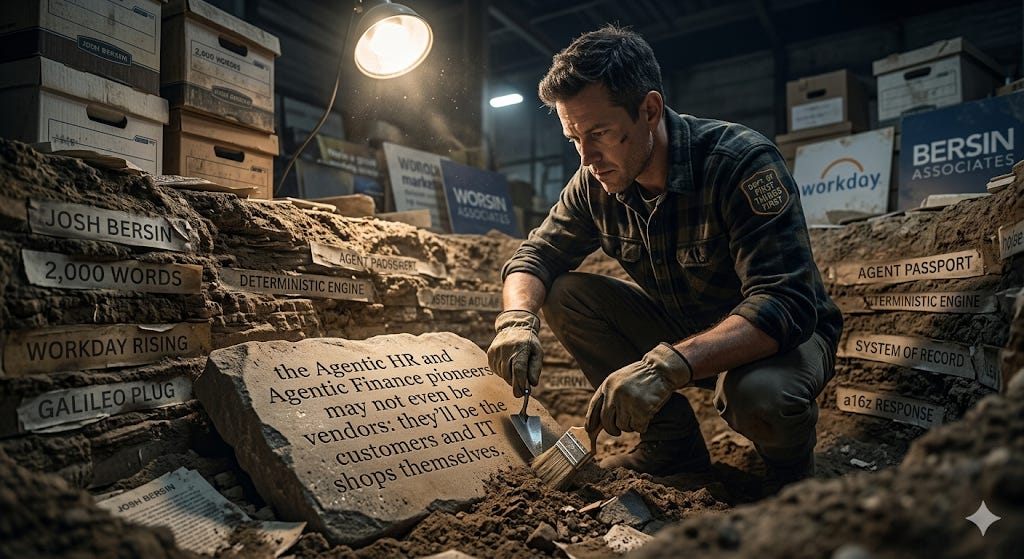
tl;dr — Josh Bersin published a defense of Workday this week, responding to the a16z piece arguing Workday is structurally cooked. Buried six paragraphs from the bottom is a single sentence saying the pioneers of agentic HR will be customers and IT shops, not vendors. He is correct. He has also accidentally written the mission statement of this newsletter, three paragraphs above a plug for the AI layer he wants to sell us.
The line is buried, six paragraphs from the bottom of a 2,000-word post. I almost missed it.
"the Agentic HR and Agentic Finance pioneers may not even be vendors: they'll be the customers and IT shops themselves."
That is the entire thesis of practitioner-led HR Tech, written in someone else's blog, by someone who has been doing this longer than I have.
It is exactly right.
It is also completely undermined by the other 1,900 words.
The Setup
For context. A partner at a16z (Joe Schmidt IV) published a long piece last week called "Workday's Last Workday?" The thesis is that HCM is the last large enterprise category without an AI-native challenger, and Workday's moat is lock-in disguised as love.
Buried in that piece is a sentence, attributed to a Workday admin Schmidt interviewed, describing Illuminate as "the same manual admin work with a chat surface bolted on."
That sentence could have been pulled from this newsletter. I have written some version of it at least five times.
Bersin's response this week is titled "A16Z Perspectives On Workday Seem Naive." He defends the consulting ecosystem. He likes the rules-as-rails framing. He says the future will arrive slowly. Some of which I agree with.
Then he buries the most important sentence in the entire HR Tech discourse this month at the bottom of the post and follows it with a Galileo plug.
The Contradiction
Most of the essay is a defense of vendor architecture. The deterministic engine. The Agent Passport. The Agent System of Record. The fact that Workday Rising has 20,000 happy attendees, which apparently proves customers do not really mind the product.
Then, near the end, Bersin takes a sharp turn.
He talks about how new architectures take years. How Workday itself was a thin platform that only became a $10B business after years of customer-led iteration. How the next wave of innovation will look more like "build it yourself" than "wait for the big vendor to deliver it all."
And then the line.
The pioneers may not even be vendors. They'll be the customers and IT shops themselves.
Which is correct. Which is the entire game. Which is why I write this newsletter.
But here is the question I cannot get past.
If practitioners are the pioneers, why is the rest of the post a defense of the vendor's worldview?
You cannot have it both ways. Either the pioneers are the customers (in which case the move is to arm them, not reassure them that the vendor's architecture is fine and slow innovation will protect everyone) or the vendor's architecture is the future (in which case practitioners are not pioneers, they are operators).
Bersin picks both. The post reads like a love letter to Workday with a footnote that says "by the way, the people in the trenches will figure this out."
(Generous title to bestow on the practitioners from inside the Sana launch press release.)
What Practitioner-Led Actually Looks Like
Here is what Bersin's last paragraph gets right, even if the rest of the post does not commit to it.
The teams I see making the most progress on Agentic HR right now are not waiting for Sana. They are not optimizing their Flex Credits spend. They are not standing in line for the Agent System of Record.
They are doing the unsexy work first.
Auditing job profiles that have not been touched since implementation. Documenting business processes nobody has looked at since 2019. Mapping their integration spaghetti into something resembling an inventory. Teaching their analysts to read an API spec.
Tuning the instruments before hiring the conductor.
When the vendor finally ships the agent, those teams will plug it into a clean system and see real output. Everyone else will plug a chat interface into a tenant full of garbage and wonder why the agent hallucinates.
That is what practitioner-led actually looks like. It is not glamorous. It does not require a billion-dollar acquisition. It does not get a press release.
It requires somebody to do the work nobody wanted to do.
The Bottom Line
Bersin's last sentence is correct. The pioneers will be the customers and IT shops. The people in the tenant. The people who get the 2 AM call when payroll breaks. The people who own the data model the agent eventually has to live inside of.
That is the whole thing. That is what this newsletter is about. That is why I write it.
The fact that the most accurate sentence in the most prominent HR analyst post of the week is one paragraph long, buried at the bottom, and three paragraphs from a Galileo plug, is its own kind of signal.
The work is ours. The credit, eventually, will be too.
We just have to do it before the analysts notice.
— Mike
Director of the Department of First Things First | Newly Crowned Pioneer
The Department of First Things First. For the people who do the work.
P.S. Justin asked what I was writing about. I told him an analyst said the people who actually do the work are going to be the heroes of this story.
He thought about it. "Dad, that's like when I do the group project and Skyler tells everyone what we did."
He is twelve. He gets it.
You are spot on. That is why this year, for my team we are in our sweatpants era. We are digging into the 23,000 abandoned transactions and identifying them and setting up mom processes to clear them out and continue to clean them up going forward. We're looking at all of the calculated fields that were created and never used the formulas that people set up and brought over and and were never actually utilized and getting rid of them. We're consolidating so that when we get asked to turn on an agent, it's actually returning usable information. We're rolling up our sleeves locking in and doing the work that nobody asked us to do but we know needs to be done because we see what's coming down the line.
And we saw it long ago so that we could prepare for the cleanup that needs to happen.
Man, I love your newsletters!!