


I was sitting in my worn pleather chair this weekend, trying to enjoy my coffee, when my 11-year-old, Justin, marched in and announced he had cleaned his room.
“Done,” he declared. “100% optimized. Record time.”
Now, I’ve been in this game a long time. I know “record time” usually means “hidden mess.” So, I conducted an audit. The floor was indeed visible. The bed was made. The Squishmallows were all lined up in a row. It looked, for all intents and purposes, like a transformative success.
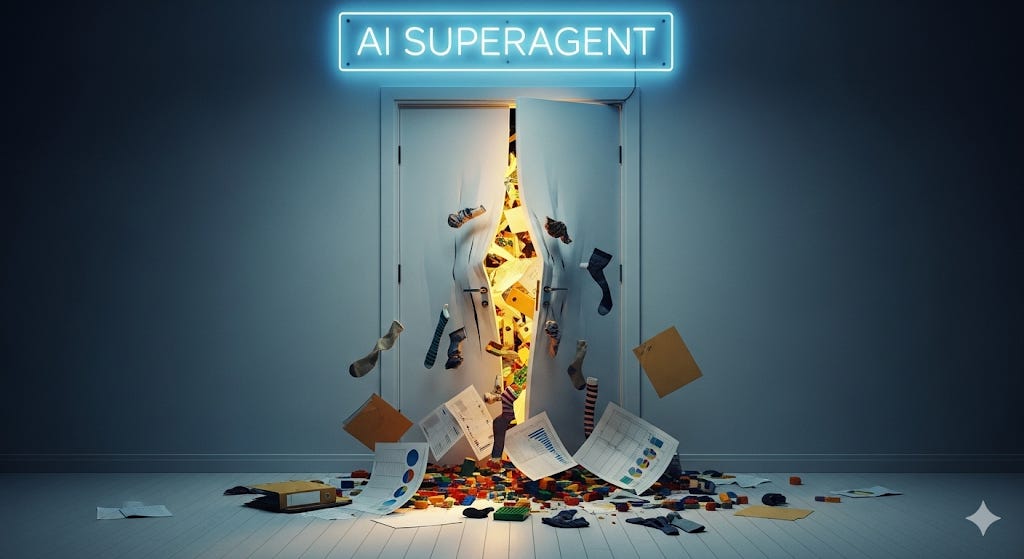
Then I opened the closet.
An avalanche of dirty socks, loose Lego bricks, three half-read books, and a wrapper for a granola bar buried me. He hadn’t cleaned the room; he had just built a nice UI (the closet door) to hide the absolute disaster on the backend.
This morning, I listened to Josh Bersin’s “2026 Imperatives,” and I realized: The entire HR Tech industry is currently acting like an 11-year-old with a messy closet.
Josh (who is the Oracle of HR, and I say that with respect) is predicting that AI “Superagents” will automate 30 to 40 percent of HR roles by 2026. He says we are entering the age of the “Superworker.”
But here in the Department of First Things First, we need to have a serious talk about what’s behind that closet door.
The “Superagent” vs. The “Super-Mess”
The premise of the “30-40% automation” stat is that AI Agents will handle all the routine, rules-based work. But that assumes your work is rules-based.
I’ve seen your backends. I’ve seen the data. It doesn’t look like the frictionless utopia in the whitepapers. It looks like a raccoon got into a filing cabinet and tried to fix the filing system using Excel macros.
The Scenario:
An employee asks the Superagent: “Hey, why was my bonus pro-rated?”
The Dream:
The Superagent analyzes the policy, checks the hire date, calculates the accrual, and politely explains the math.
The Reality:
The Superagent checks the system and sees:
The employee’s hire date is in the future because of a data migration error from 2019.
Their “Bonus Plan” field is blank because their manager, Steve, hired them into a “TBD” job profile that doesn’t exist anymore.
The actual bonus calculation lives in a spreadsheet on a shared drive called
FINAL_FINAL_v3_DO_NOT_TOUCH.xlsx.
So the Superagent returns the only answer it can: “According to my records, you do not exist. Have a nice day.”
The 30-40% of roles aren’t going away because those roles aren’t “doing the math.” Those roles are cleaning up the mess caused by the fact that your systems don’t talk to each other. You cannot automate a process that relies on “Asking Janet because she remembers how we did it during the merger.”
The First Things First Take: We’ve talked about this before: An AI Agent running on dirty data isn’t a “Superagent.” It’s just a High-Speed Hallucination Machine.
The “Superworker” Fallacy
Bersin talks about the rise of the “Superworker”: the tech-savvy, independent high-performer who uses AI to be 10x more productive.
And yes, these people exist. They are usually the ones writing the Python scripts to bypass your IT security protocols.
But for every “Superworker,” there are 5,000 employees I call “Password Reset Pete.”
Pete is a great guy. He’s great at sales. But Pete has not successfully logged into Workday on the first try since before the pandemic. Pete thinks “Multi-Factor Authentication” is a personal attack.
If you deploy a complex AI ecosystem that requires “prompt engineering” skills to navigate, you aren’t empowering the Superworker; you are effectively firing Pete.
The “Establishment” view assumes everyone is a digital native. The “Kitchen Table” view knows that half your workforce still prints out PDFs to sign them with a wet pen, scans them, and emails them back as a JPEG embedded in a Word doc (you should see some of the resume formats I’ve seen…SMH).
The First Things First Take: You don’t need a “Superagent” for the Superworker. You need a “Simple Button” for Pete.
The Establishment Grift (Or: Why We Buy The Roof Before The Foundation)
Why is the sky always falling? Why is it always a “Revolution”?
Because “Stability” doesn’t sell software licenses.
If a consultant came to you and said: “Hey, the biggest innovation for 2026 is actually enforcing a strict naming convention for your Supervisory Organizations and cleaning up your cost center mapping.”
You wouldn’t pay them $500 an hour. You’d show them the door.
But if they say: “We need to leverage the Generative Pre-trained Transformer to create an Agentic Workflow Layer...”
BOOM. Here’s the checkbook.
The industry is incentivized to sell you the roof (AI) before you’ve poured the foundation (Data Governance). They want you to buy the Ferrari when you’re currently driving a 1998 Honda Civic with three wheels on a dirt road.
The Department’s Manifesto (What You Can Do TODAY)
Are we Luddites? No. AI is real, and it’s powerful. But like Justin’s room cleaning “system,” it only works if you actually do the work.
Here is how you actually prepare for 2026:
The “Janet” Audit: Find the person in your org who “just knows how to fix it.” Sit with them. Document what they do. If the process exists only in Janet’s head, it cannot be modeled. If it cannot be modeled, it cannot be automated.
The Security Smackdown: Go look at your “HR Administrator” security group. Does it have 400 people in it? If you don’t fix this, your Superagent will happily tell an Intern how much the CEO makes. That’s not a bug; that’s a feature working correctly on bad security configuration.
Data Governance is the New AI Strategy: Be the person who creates a “Data Dictionary” that people actually use. If you can’t get three VPs to agree on the definition of “Headcount” today, an AI is not going to magically create consensus tomorrow.
Conclusion
The “Biggest HR Transformation in Decades” isn’t about robots taking our jobs. It’s about the industry finally realizing that we cannot build the future on a foundation of spaghetti code and handshake agreements.
So, let the pundits talk about the Superagents. In the Department of First Things First, in Q1 we’ll be over here fixing the “Effective Date” logic on the integration file.
Because until that works, the Superagent is just a really expensive paperweight.
Yours in the trenches,
Mike
Director, HR Tech | Chief Closet UI Inspector
P.S. Justin eventually had to clean the closet for real. It took him three hours. There was no shortcut. I suspect our data cleanup projects will feel exactly the same.
P.P.S. If you’re a vendor selling a “Zero-Touch Implementation,” and “Full Unstructured Data Ingestion” please lose my number.
Excellent analysis! The analogy of the hidden mess behind the closet door perfectly illustrates a critial challenge with rapid AI integration. How do we ensure the 'backend' of these 'Superagents' genuinly empowers human workers, rather then just masking deeper systemic issues? Your insight here is truly valuable.