


tldr;
a16z partner Joe Schmidt just published a piece arguing HCM is the last enterprise category without a serious AI-native challenger, and they want to fund the company that replaces Workday. He even put his email in the post.
The diagnosis is half-right. The UI is brutal. Admins do absurd workarounds. Illuminate is a chat surface bolted on top of a forms-and-approvals engine. All true.
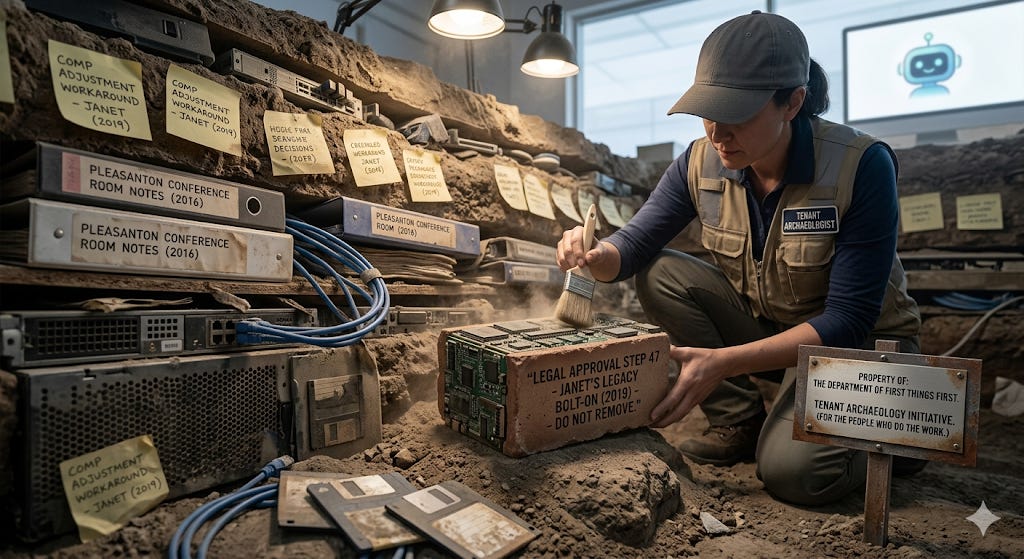
The cure is a fantasy. The reason you can't replace Workday isn't its architecture. It's that your tenant is a ten-year archaeological dig of decisions nobody documented.
A new vendor doesn't dissolve that fortress. You do. Again. From scratch. For three more years.
Joe Schmidt at a16z published a piece this week called "Workday's Last Workday."
I want to be clear up front: it's good. It's not the lazy "AI will eat ERP" take we've been seeing on LinkedIn for two years. He talked to admins. He understands the Illuminate critique. And he literally put his email in the post: build this, I'll fund you.
Respect.
But this is where the venture brain and the practitioner brain part ways.
Schmidt thinks the moat is the architecture. He thinks 100% renewals signal lock-in, not love (correct), and that the lock-in is technical (incorrect). He thinks if you build a multi-tenant HRIS in 2026 with agents instead of forms, the Fortune 500 rips out Workday the way they ripped out PeopleSoft.
They won't. And not because Workday is invincible.
Because the fortress isn't Workday.
What your tenant actually contains
When you log into your Workday tenant, you are not looking at "an HRIS." You are looking at a decade of decisions your company made about how it runs.
Why does Job Profile 47 require an extra approval from Legal? Because in 2019 someone in Compliance flagged a weird thing during an acquisition and a step got bolted on. Nobody wrote it down. Janet remembered. Janet retired in 2023.
Why does the comp business process branch differently for grade 19 versus grade 20? Because the original design decision was made in a conference room in Pleasanton during implementation, the consultant left, the BP still works, and nobody is going to touch it.
Why are there four custom fields on Position called "Strategic_Indicator_Old_DO_NOT_USE"? Because we tried to deprecate them in 2021, three integrations broke, we ran out of cycles, and now they're cursed.
Multiply that by every business process, every security group, every condition rule, every calc field, every validation, every integration. That is your tenant.
That is the fortress.
Schmidt's pitch is: rebuild this on agents instead of forms.
Cool. Who's going to make the four thousand decisions about how it should work?
The same people who made them the first time. Sitting in the same conference rooms. With the same competing priorities. For three more years.
The Tessera analogy doesn't hold
Schmidt points to Tessera doing AI-native SAP migrations at Fortune 500 scale and argues HCM is the same shape of problem at smaller surface area.
It isn't.
ECC-to-S/4HANA is an SAP-to-SAP migration. Vendor-supplied tooling. Vendor-supplied schema. Vendor-supplied incentives (SAP literally end-of-life'd the old version). Workday-to-Greenfield has none of that. There's no shared schema, no migration toolkit, no friendly Workday SE on the call helping you map fields. Every business object has to be re-derived from scratch by humans who already have day jobs.
You're not migrating data. You're re-deriving institutional knowledge.
The seventeen comp adjustments
Schmidt opens with a great image: an HR admin copying seventeen comp adjustments from a spreadsheet into Workday, one field at a time, while a business partner watches on Zoom.
Yes. That happens. I have been in that meeting.
But ask the next question. Why is the admin doing it that way?
It's not because the comp module can't bulk-load. It can. It's because someone, somewhere, doesn't trust the data feeding it. Or there's a legacy approval workflow that doesn't fire correctly when you push it through the API. Or Compliance inserted a manual review step in 2018 and nobody has the political capital to remove it.
The AI agent answer is: automate the workaround.
The architect answer is: kill the workaround.
These are not the same thing. And the AI-native challenger that ships in 2027 will be automating workarounds in their own tenants by 2030. Because that's what humans do. We accumulate workarounds. The system does not.
What $40M actually buys
If someone takes Schmidt's email seriously and builds this thing, here's what they'll discover after three years:
They will have rebuilt Workday. Not "Workday for the AI era." Workday. With a chat interface. Because the Fortune 500 will demand the same compliance, the same payroll determinism, the same security model, the same audit trail, the same data residency, the same SOC 2, the same FedRAMP. And over five years the new vendor will accumulate the same forms-and-approvals scar tissue, because the customers will demand it.
The new system of record looks exactly like the old system of record. Only the founders are richer.
What's actually happening
The future of HR Tech isn't a Workday replacement. It's a Workday subordinate.
The deterministic engine stays. Payroll runs. Compliance holds. The system of record does what it is good at: keeping the company out of jail and the paychecks correct. Sitting on top of that, the experience layer goes feral. Conversational interfaces. Agents that handle orchestration. Sana, Phenom, ServiceNow, whatever wins the front door. You never see the BP. You never click through fourteen steps.
That is happening. It is happening now. It does not require a16z to fund a greenfield.
It requires the practitioners who actually run these systems to do the unsexy work of cleaning the data, rationalizing the integrations, and building the governance layer that makes the agents trustworthy.
The fortress isn't Workday.
The fortress is the body of decisions encoded in your tenant.
A new vendor doesn't dissolve that fortress.
You do. With a wrench. On a Tuesday morning.
— Mike
Director HR Tech | Tenant Archaeologist
The Department of First Things First. For the people who do the work.
P.S. Justin came to me last week and said he could "build a better Roblox in a weekend." I asked him what game engine he would use. He said "what's a game engine." Dear reader, a16z would fund him.