


tldr; Josh Bersin wrote a glowing breakdown of Workday's Sana announcement. He also disclosed (paragraph one) that he's a Sana customer and partner whose own product runs on it. The piece is a well-lit infomercial dressed as analysis — and the questions a practitioner would actually ask never make it on screen.
"Built in" is doing a lot of work. Workday's security model isn't two words. It's domain policies, BP policies, constrained groups, intersections — and none of that translates cleanly when an agent pulls Slack data into a Workday comp profile.
"Thousands of agents" is a loaded gun, not a feature. Who approves them? Who audits them? What happens to API performance when 1,000 custom agents start polling Workday at once? Josh doesn't ask. You have to.
ASOR gets one mention. In parentheses. For a guy who coined "Intelligent Orchestration," the actual orchestration layer gets less screen time than the Galileo sales pitch.
The Copilot collision Josh skipped. Your CIO already paid for Microsoft Copilot. The question isn't "is Sana better than Copilot" — it's "is Sana better enough to justify funding two AI front-ends after we told the board we were consolidating."
Disclosure ≠ objectivity. Telling me you own the stock doesn't make the analysis objective. It just tells me why it isn't.
The Form Check. Six things your team should be interrogating right now — security inheritance, agent approval pipelines, data lineage, hallucination monitoring, migration paths, and real TCO (not sticker price).
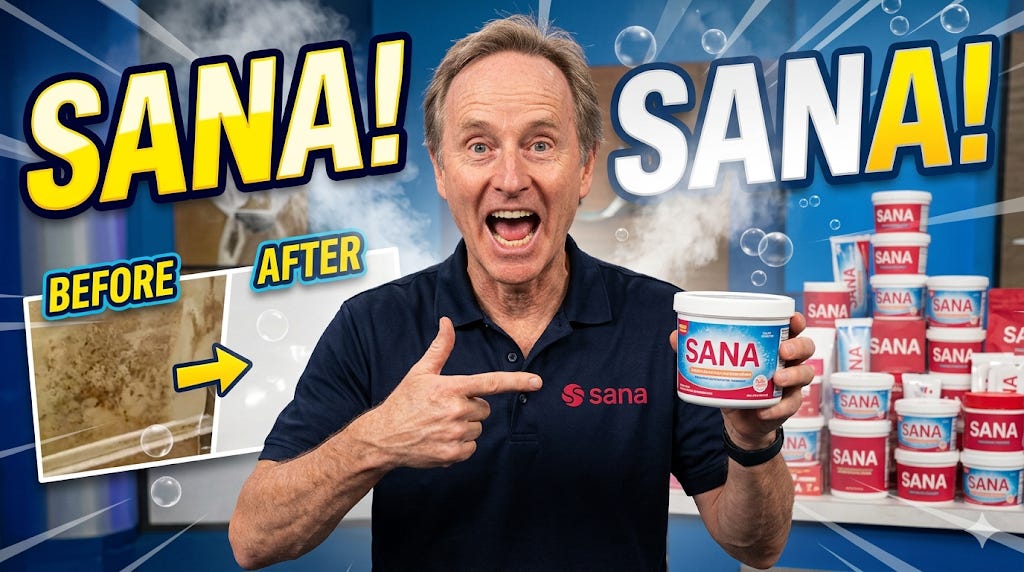
It's 2:00 AM. You can't sleep. You're flipping channels.
And there he is. Perfectly lit. Radiating confidence. Leaning into the camera with the energy of a man who has personally tested this product and needs you to know about it.
"HI, I'M JOSH BERSIN, AND I’M HERE TO TELL YOU ABOUT SANA!"
The demo is flawless. The stains disappear. The before-and-after is stunning. Four amazing product features, each one bigger than the last. And right on cue — the call to action:
"Call us if you want to walk through the details."
I had a Billy Mays moment this week. You know the one. Where you're watching what looks like industry analysis, and then the camera pulls back and you realize…Oh! This is an infomercial. And the host is really good at it.
The Disclosure That Changes Everything (And Nothing)
To his credit, Josh tells you the deal right up front in paragraph one. He's a Sana customer. He's a Sana partner. His product, Galileo, runs on Sana. He's been using it for three years.
That's honest. I respect that.
But here's the thing about disclosure: it's necessary, but it's not sufficient. Telling me you own stock in the company doesn't make your stock analysis objective. It just means I know why it isn't. And once you know that Josh Bersin is reviewing his own landlord's renovation while selling condos in the building, every sentence reads differently.
Let's walk through his four big announcements the way an enterprise practitioner hears them. Which is: differently.
Announcement 1: All Workday customers get access to Sana for Workday.
Sounds incredible. What does "access" mean?
Is it bundled with existing SKUs? Is it a freemium play with an upsell? Is there a per-user cost? Per-transaction? Does my current contract cover it or is this a massive change order?
Josh doesn't say. A CHRO doesn't ask. But you — the person who manages the vendor relationship, reads the SOW, and explains the budget impact to the CFO — you're already reaching for your Workday rep's number.
(They're not going to pick up. The pricing is still "TBD." You know this.)
Announcement 2: Sana Enterprise connects to Salesforce, Teams, Slack, and more.
Multi-system integration through a single AI front-end is genuinely interesting. But here is what Josh calls Workday's security model: "built in."
Two words. For the most complex permission framework in enterprise HR technology. Domain security policies. Business process security policies. Constrained and unconstrained security groups. Intersection configurations.
"Built in." That's like saying OxiClean works on "all fabrics." Technically, the box says that. But you and I both know there's a reason the demo always uses a white t-shirt and never your grandmother's silk blouse.
But the real nightmare isn't just Workday's security; it's security translation. When Sana pulls a Slack message and pairs it with a Workday comp profile, whose security model wins? If an agent uses an Integration System User (ISU) to connect Workday and Salesforce, how does it respect field-level security across two entirely different data models?
The infomercial shows someone asking Sana for their PTO balance and getting a clean, happy answer. It does not show the data breach review after an agent surfaces comp data to someone in a view-only job requisition role because the integration couldn't translate the constrained security group.
Announcement 3: You can build your own agents in Sana.
Josh says: "Companies will build thousands of these agents."
Thousands.
My son, His Highness Justin (almost 12), can spin up a custom Roblox server with custom mods in ten minutes with zero oversight. Do I want an enthusiastic compensation analyst building a Workday agent with that same level of friction?
Who monitors for hallucination? Who audits data access patterns? What's the version control story? What happens when that comp analyst inadvertently exposes salary band data because the security inheritance isn't what they assumed? Or worse, what happens to your system performance when 1,000 custom agents start continuously pinging Workday's APIs to check for status updates?
Josh describes a loaded gun and spends the whole segment talking about how shiny it is.
The safety doesn't get mentioned. Not once.
Announcement 4: Sana's AI infrastructure becomes Workday's AI infrastructure.
Josh says the Illuminate brand is essentially being absorbed. New agents will be built within Sana's infrastructure going forward. Cool.
But what happens to the governance framework? Workday just spent a year training the ecosystem on how to govern Illuminate via the Agent System of Record (ASOR). Now they bought a completely new engine. Does the ASOR governance framework survive the transplant, or are we back to square one?
Want to know how seriously Josh takes ASOR? He mentions it once. In parentheses. Literally in punctuation designed for afterthoughts. He calls it "critical"…and then treats it like a footnote. For a guy who coined "Intelligent Orchestration," the actual orchestration layer gets less screen time than the Galileo sales pitch.
And when it comes to Paradox, HiredScore, and the rest of Workday's recent acquisitions? Josh's answer is: "will come out over time." If you're a customer who just finished a HiredScore integration, that sentence should make your eye twitch. Workday spent serious money acquiring these tools. You spent serious effort implementing them. "Will come out over time" is the analyst equivalent of thoughts and prayers.
The Boardroom Collision Josh Ignored
Josh's competitive landscape section is polite. Oracle gets two sentences. SAP/Joule gets a nod.
But there is a massive, existential boardroom collision coming, and Josh completely sidesteps it.
If you are an enterprise shop, you probably already have Microsoft Copilot. Not because you chose it, but because it came with the E5 agreement you signed two years ago. It's already in the budget. Already past procurement. Already blessed by InfoSec. Already in the SSO flow.
Now imagine walking into your CIO's office and saying: "I need budget for a second AI platform."
The CHRO wants Sana because it's "HR native." The CIO wants Copilot because it's already deployed and paid for. The question isn't "Is Sana better than Copilot?" Features comparisons are easy. You can build a slide for that.
The question is: "Is Sana better enough to justify paying for both?"
That is a "why are we funding two AI front-ends when we told the board we were consolidating vendor spend" conversation. And it's a conversation you can't objectively write when your own product runs on one of the platforms being evaluated. A practitioner actually has to live in that overlap. You have to answer the question your CIO will absolutely ask: "Can't we just build a Workday connector in Copilot Studio?"
Maybe the answer is yes, Sana is worth it. Maybe the Workday-native security layer and the learning platform integration genuinely differentiate it. But that argument has to be made with math, not with a Billy Mays demo. And the person who has to make that argument is you. Not Josh.
The Form Check: What You Should Actually Be Asking
Maybe Sana clears every one of these questions. Great. Let's see the test results. The point isn't that the answers are bad. The point is that nobody is asking the questions out loud, and somebody has to.
If Workday is serious about Sana as the agent infrastructure, here is what your team needs to be interrogating right now:
Security Inheritance Validation: Don't trust "built in" until you've tested it. Build test cases that intentionally cross security boundaries. Verify that Sana respects domain security, BP security, and field-level security independently across integrated systems.
Agent Inventory and Approval: If "thousands" of agents are coming, you need a pipeline. Not a free-for-all. Who approves them? Is there a review board? A sandbox environment? A staging process?
Data Lineage and Auditability: When an agent surfaces an answer, can you trace where that data came from? Which Workday report or data source did it pull? Was it real-time or cached? If an agent gives a wrong answer that leads to a business decision, can you reconstruct the logic?
Hallucination Monitoring: LLMs hallucinate. Period. What's the monitoring framework for agent-generated responses? Is there a confidence threshold below which the agent declines to answer? Who reviews flagged responses? Nobody has a great answer for this yet. That's exactly why you need to be asking.
Migration and Coexistence: If you've invested in Illuminate, what's the migration path? If you've built custom apps on Workday Extend, what's their future in a Sana-native architecture? Get it in writing. "Will come out over time" is not a migration plan.
Cost Modeling: What's the Total Cost of Ownership? Not just the sticker price, but the incremental FTE for agent governance, the change management burden, and the opportunity cost of not spending that budget elsewhere. Especially if you're already paying for Copilot.
The Laundry Room
Here's the thing about Billy Mays. He wasn't a con man. OxiClean actually works.
But Billy Mays didn't invent OxiClean. He was a paid endorser who did demos under perfect studio conditions. The lighting was right. The stain was pre-selected. And the camera cut away before you saw what happened when you tried it on the wrong material.
That's this article. Sana might be legitimately great. Josh clearly loves using it.
But this piece isn't strategic analysis. It's a guy in a blue shirt doing a demo with a white t-shirt and a perfect stain, under studio lighting, with a 1-800 number at the end.
The part the infomercial never covers is what happens when you get home, open the box, and try it on real fabric with real stains in your actual laundry room. That part has a name. It's called enterprise architecture.
And the stains are real.
-Mike
The infomercial ends. The laundry doesn't. Subscribe to The Department of First Things First.