


tldr;
I like to teach Justin where things started. Music, science, the whole origin tour. Last night it was Zork, the game that defined the text adventure (yes, Adventure came first, hold your letters).
He walked into a dark room without the lamp and got eaten by a grue almost immediately. Indignant. “The game didn’t tell me.”
It didn’t. Nobody documented it. Which is the exact reason your tenant has rooms you’re scared to walk into.
The origin tour
I have this thing I do with my son.
I show him where stuff started. Not the polished version. The origin through the genre-definier. We went from Muddy Waters, to Elvis, to the Beatles, to Springsteen, and then U2 (and discussed cultural appropriation along the way). From “why does the apple fall” to Newton actually writing it down. He’s eleven, twelve now (the birthday snuck up on me), and he’s got a better sense of where things come from than most adults I work with.
So last night I committed an act of parenting I’d been putting off for years.
I made him play Zork. The genre-defining text adventure. I was about his age when I first shoved a 5 1/4” floppy disk into the drive of a school Apple IIc to start my text adventure, and now it’s his turn. Just no more floppy disk. Time to go find it on Steam.
(And yes. I know. Colossal Cave Adventure predates it. Crowther and Woods got there first. I’m aware. But being first and defining the genre are two different things, and Zork is the one everybody else copied. Hold that thought. It’s going to matter at the end.)
Ninety seconds to a grue
Here’s how it went.
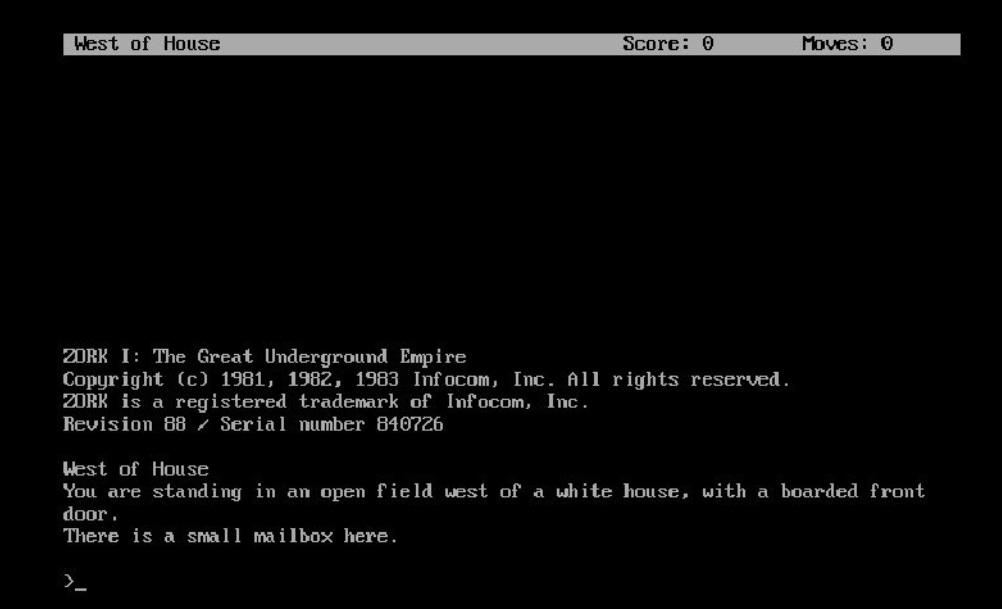
Justin, digital native, raised on games that hold your hand through a forty-minute tutorial, stares at a black screen that says “West of House.” No graphics. No arrow telling him where to go. Just a blinking cursor and the quiet contempt of 1980.
He finds the mailbox. He finds the house. He’s actually doing great.
Then he goes down. Into the dark.
It is pitch black. You are likely to be eaten by a grue.
He types “go forward.”
He gets eaten by a grue.
He is OUTRAGED. “The game didn’t tell me I needed a light! How was I supposed to know?”
And I’m sitting there, trying not to laugh, watching my kid die in a forty-five-year-old game, and all I can think is: buddy, you just described every Workday environment I have ever walked into.
Your tenant has dark rooms
You operate in the light most days.
The stuff you touch every week is well-lit. You know where the switches are. You could move through it with your eyes closed.
But every tenant has dark rooms.
The integration that’s been running since 2019 that nobody can fully explain. The security group named “TEMP_2021” that turns out to be load-bearing. The calc field with a comment that just says “ask Barb.” (Barb left in 2022.) The business process with one step everyone is afraid to touch, because the last person who touched it caused a Career Limiting Event.
Those are dark rooms. And the thing about a dark room is that it’s completely fine. Right up until somebody walks into it.
A release drops. A vendor changes an API. A new analyst gets handed the keys and goes exploring. They walk into the dark, confident, with no light.
And the grue eats them.
The lamp is documentation. The lamp has a battery.
In Zork, the fix is simple. You grab the brass lantern from the living room before you go underground. The lamp is how you survive the dark.
In your tenant, the lamp is documentation.
Not the kind the SI handed you at go-live. That’s “what” documentation. “This integration moves data from A to B.” Great. Useless the second something breaks. Because when it breaks, you don’t need to know WHAT it does. You need to know WHY it was built that way. Why the field maps like that. Why that condition exists. Why somebody, three years ago, made a choice that looks insane until you understand the constraint they were under.
Most documentation tells you what. Almost none of it tells you why.
And here’s the part of Zork nobody remembers until it bites them.
The lamp has a battery.
It runs out. You can be standing in a perfectly safe room, lantern in hand, and the light just... dies. Because you wandered too long without a plan.
Tribal knowledge is a lamp with a battery.
The person who knows why the integration is built that way is your light source. And the day they take a new job, or go on a two-week vacation, or (the email we all dread) get hit by a bus, the battery dies. The room goes dark. And nobody left in the building remembers where the grue lives.
Month 14 is when the lights go out
There’s a specific moment this happens, and if you’ve lived it you already feel your stomach tightening.
The SI’s statement of work expires. The consultants pack up. The “what” documentation gets filed in a SharePoint nobody opens. And about a year later, something breaks in a room only the consultants ever walked.
You go to look. Pitch black.
You reach for the lamp. The battery’s dead. Everyone who carried it is gone.
That is a governance problem. You let your whole operation depend on light sources you didn’t own and couldn’t recharge.
How to not get eaten
You don’t fix this with a tool. You fix it with a walk.
Walk your dark rooms before the grue does. List every part of your tenant where exactly one person holds the light. That’s your bus factor. Every name that shows up once is a battery you don’t control.
Then write down the why. Not the what. The why. The constraint, the decision, the thing that’ll look batshit crazy to the next person who walks in cold.
It’s boring. It’s unsexy. It does not demo well. Nobody is putting “we documented our integration rationale” on a slide with a gradient.
But it’s the difference between an org that can lose a key person on a Tuesday and an org that goes pitch black the moment they do.
(I built a quick self-audit for exactly this. Five minutes, finds your dark rooms. Closest thing I’ve got to a flashlight you can keep. Link’s around here somewhere.)
The genre-definer, revisited
Remember the thing I made you hold your letters about?
Adventure came first. Zork defined the genre.
Workday wasn’t first either. PeopleSoft was running payroll while Workday was still a slide deck. SAP predates all of us. (I once worked for a vendor which built it’s payroll engine in COBOL. In 1977. Yes, they’re still around. I hope for my friend Earl Foster’s sake PASPR50.exe has been relegated to the great code gig in the sky.) But Workday defined the modern category, and everyone’s been responding to it since.
Being first is a footnote. Defining how everyone else thinks about the problem is the whole game.
Which is the actual reason I make my kid play the remake instead of the origin. The remake shows you what won. The origin shows you why.
Right now, in your tenant, somebody is about to walk into a dark room and reach for a lamp that isn’t there.
Grab the lantern. Write the why. Walk the rooms while you still have light.
The grue is patient. It’s been waiting in your tenant since 2005.
— Mike
Director HR Tech | Reformed Grue Bait
P.S. After dying twice, Justin asked me if real jobs have grues. I told him every single one does, buddy. Some of us just call them “undocumented integrations.” He nodded like it was the most obvious thing in the world. Then he grabbed the lamp and went back in.
P.P.S. What makes this gig fun is that story ideas come from everywhere. Laura Horton wrote a quick LinkedIn post which started these wheels turning when she posted about Workday config being a choose your own adventure story. That reminded me of Zork, then my failings as a parent, and then the fun began. Thanks Laura.
The Department of First Things First. For the people who do the work.