


tl;dr
My son Justin just completed an order for 16 custom 3D-printed side tables for our tennis club. He almost passed on it before he started, because he didn't think he could do it.
Once he got out of his own head, he did exceptional work: researched a Creative Commons base design, modified it for tennis (added ball holders so balls don't roll away), and proposed adding the club's logo. The owner ordered 16 on the spot.
The framework that closed the deal is the same one that closes any deal, in any industry. Listen to the actual problem. Show up with a working solution. Add the detail nobody asked for. The hardest part is usually getting yourself to start.
Our tennis club just installed Zenniz line-calling on every court. If you don't follow tennis tech, it's basically Hawk-Eye for amateur clubs. Cameras, AI, automatic line calls. It's slick, it works, and it's almost entirely killed the line-call argument that has been ruining doubles matches since the invention of doubles matches.
It also killed our courtside tables.
The little tables that used to bolt onto the net post had to come off to make room for the main system mount. So now there's nowhere to put a water bottle, a phone, or a tube of balls between sets. Players were grumbling. The owner was hearing about it constantly. Nobody had a good answer (I know, first world problem. I fully acknowledge my privilege).
Jenn and I were talking about it on the way home from a clinic, and she said the obvious (AKA smart) thing.
"Why doesn't Justin 3D print one?"
She floated the idea to the owner. He was interested. One of his juniors was going to help out the club. He didn't need a deck. He didn't need a roadmap. He needed a table that could survive a tennis club.
Then we told Justin.
The Part Where He Almost Bailed
Justin's first reaction was not enthusiasm.
He actually screamed "I can't do that,” and promptly hung up the phone on his Mom.
Now, let’s put his reaction into perspective. He runs a four printer farm in our basement. He's been modeling in Fusion 360, Tinkercad, Canva, and Bambu Studio since he was ten. He has produced more functional, finished objects in the last year than most adults will in their lifetime. None of that mattered in the moment. The minute it became real, with a real customer expecting a real product, his brain immediately went to all the reasons he wasn't the right person for it.
It was too big. He'd never done a real order before. What if it didn't fit together? What if the panels warped? What if the owner hated it? What if, what if, what if.
This is, by the way, a very specific feeling that I have watched grown adults experience (me too!) in conference rooms hundreds of times. Same posture. Same furrowed brow. Same internal monologue. "I'm not the right person for this." Mostly delivered by people who, by every measurable standard, are exactly the right person for this.
This time, it took one conversation once we got home. Some "you have literally already built harder things than this." Some "the worst case is the owner hates it and we eat the filament cost." Some appeals to the obvious upside (real money, his name on a product in a real business).
And then, somewhere between the third and fourth point, the imposter syndrome shut off and the maven flipped on.
What He Actually Did
From that point forward, he was sprinting.
He found a Creative Commons table design he liked as a base (because the smart move is never to start from scratch when somebody has already solved 60% of the problem for you). He modified the dimensions to work as a courtside companion. He sized it to drag around for tournaments without throwing your back out, but strong enough to be knocked around and not break.
Then he made two decisions that I want to flag, because they are the entire ballgame.
First, he added circular ball holders to one of the panels.
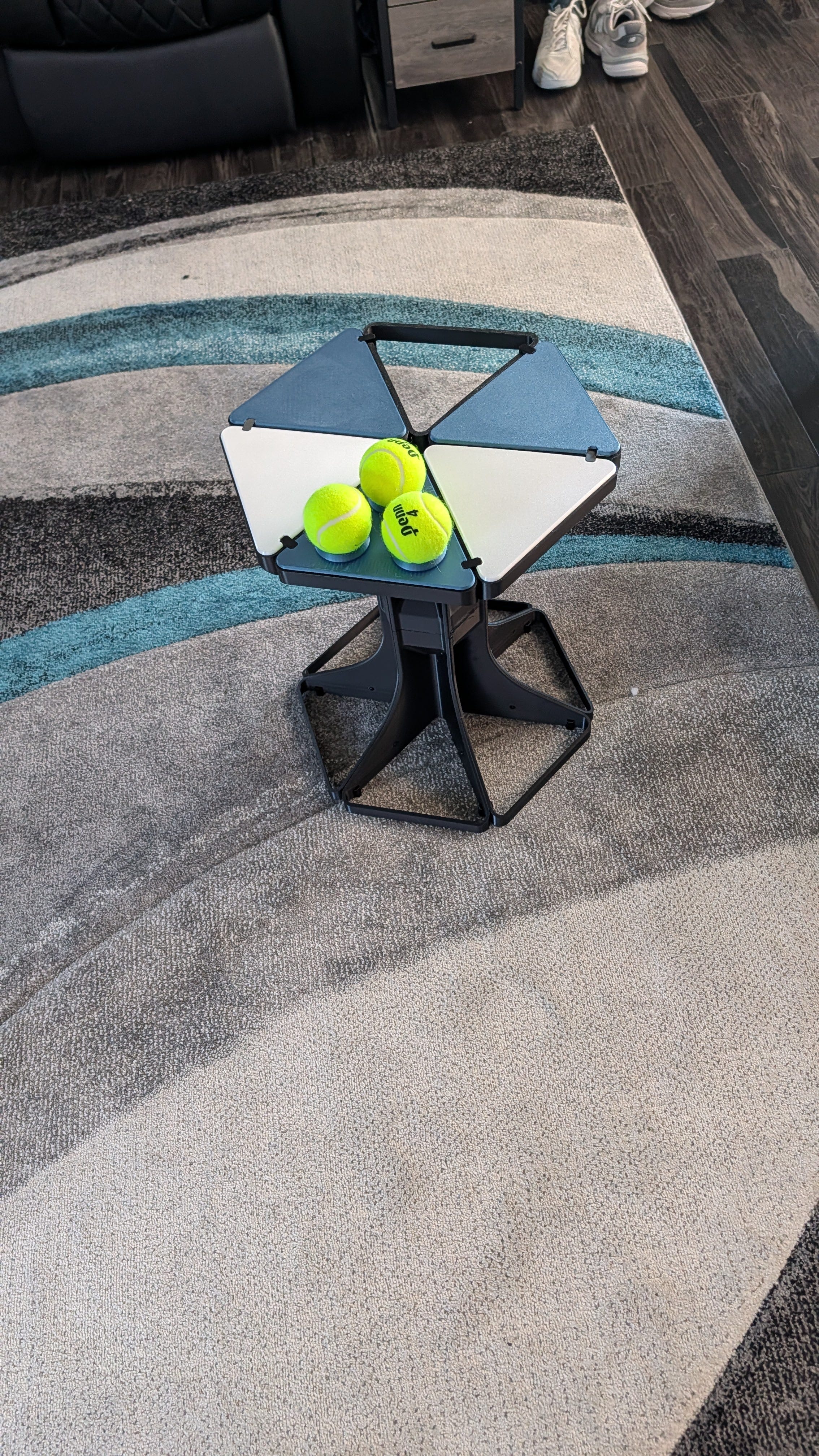
Three little wells, sized to hold a tennis ball, so they don't roll off the table the second you set them down. Anyone who has played tennis for more than fifteen minutes knows this is the single most relatable design problem in the sport. Tennis balls are round. Round things roll. Tables are flat. Flat plus round equals annoyance. Justin solved for that, on his own, because he plays the sport and he has personally experienced the exact moment of frustration the table needs to fix.
Nobody asked for ball holders. He just understood the use case.
Second, he proposed the club's logo on the top.
Not a sticker. Painted on with a machine. Multi-color, right on the panel. The owner had not asked for any branding. Justin offered it because, on some intuitive level, he knew that a generic side table is something you order from Amazon. A side table with the club's logo on it is something the club owns.
The logo is the difference between a piece of furniture and a piece of identity.
He built the prototype. Hexagonal top, triangular panels in the club's colors, structural base in black PETG (stronger plastic to survive being knocked around), ball holders, logo on top. Walked it into the pro shop. The owner picked it up, set a Gatorade on it, looked at the logo, and ordered sixteen.
A sample is in the photo (above). The last panel is currently out at a vendor getting the logo printed. The basement smells like warm plastic. There is a four-printer relay running in shifts. Toby has assigned himself to quality assurance and currently sleeps on the couch next to the “farm”. We are operating at full tilt, and Justin has, in the last 72 hours, gone from "I can't do this" to texting me production schedules.
It is a hell of a thing to watch.
The Three Things That Closed the Deal
This whole story comes down to three moves. They are stupidly simple, and they apply whether you are selling tables, software, or services.
Listen to the actual problem
Not the problem in a category report. The problem the customer is actually complaining about, in actual words, in the actual room.
Jenn heard it first. The Zenniz install created a real, specific, daily friction. Players had nowhere to put their stuff. The fix didn't need to be sophisticated. It needed to be a table.
How many vendor demos have you sat through where the AE has clearly never read your annual report? Where the discovery call was a checklist of features they wanted to demo, not questions about what you actually need? Where they show you the agentic AI demo when you said the meeting was about merit planning? The reason most enterprise software pitches fail is not that the product is bad. It is that nobody bothered to find out what the customer was actually trying to do.
Show up with a working solution, not a roadmap
The owner was interested in the concept when Jenn mentioned it. But the order didn't happen until Justin walked in with a thing the owner could pick up.
That is a profoundly different sale. The buying decision was not "do I trust the roadmap." The buying decision was "do I want sixteen of these."
The HR Tech version of this is the team that walks into a steering committee and says "I built a working prototype of the thing you asked for, here is the screen, here is what happens when I click this button" versus the team that walks in with a Visio diagram, a list of dependencies, and a Q3 milestone called "TBD."
Which team gets funded? You already know.
Add the detail nobody asked for
Logo. Ball holders. Pick your favorite.
The logo is the obvious customization (branding makes it feel owned). The ball holders are the non-obvious one, and they are the more important one. The ball holders only exist because the person designing the table actually plays the sport and has personally lived the moment of frustration the design needs to solve.
That is practitioner empathy (Thanks Jerome!). It does not come from a requirements document. It does not come from a workshop. It comes from someone who has been in the seat the customer sits in.
In Workday terms, the logo is the embedded help text and the org-specific landing page. The ball holders are the business process change you made because you knew the manager was going to bounce out at step seven if you didn't change that approval to a notification. Both matter. The second one is what separates implementations that get adopted from implementations that get tolerated.
The Fourth Thing, Which Almost Killed the Deal
The framework above describes what Justin did. It does not describe the part that almost stopped him from doing any of it.
He almost said no.
Before the design. Before the research. Before the prototype. Before the order. There was a moment where the entire deal hinged on a 12-year-old's willingness to believe he was the right person for the work.
If a 12-year-old with a 4-printer farm can see the path through the fear, why are we, with 20 years of logic-based experience, still stalling? You have sat on an idea you knew was right because "that's not really my call to make." You have deferred to a consultant on something you knew more about than they did. You have watched a vendor pitch a half-baked solution to your CHRO and not pushed back, because who are you to push back? You have written a draft of a recommendation that you knew was correct and never sent it, because, “what if you were wrong?”
The work was never the hard part. The hard part is always the moment before the work, where you decide whether you are the kind of person who does this thing or not.
The HR Tech industry has a chronic, unaddressed practitioner-confidence problem.
The people closest to the system, the ones who actually understand the data model, the security framework, the manager experience, are constantly deferring to people who are paid more, sit higher, or talk faster. Meanwhile, the analysts publish, the consultants bill, the vendors demo, and the practitioners stay quiet. We treat "I'm just the admin" as humility when it is actually the single biggest blocker to better systems.
Justin almost talked himself out of his first big sale. You have probably talked yourself out of your last good idea. That's the bigger story.
The Bottom Line
The framework is real and it works. Listen, prototype, add the detail nobody asked for. You will close more deals, internally and externally, than the people who don't.
But the framework only matters if you actually start. And the part that nobody warns you about is that starting is the hardest part of every meaningful piece of work you will ever do.
My 12-year-old got over it in one conversation. Some practitioners I know have been stalling on the same idea for three years.
Be more like Justin. Once he flipped, he did not look back.
— Mike
Director HR Tech | Production Support, Domingo-True Lab
P.S. Justin asked me last night what his “profit margin” should be. I told him to factor in materials, electricity, printer wear, and his time. He thought about it for a few seconds and said, "What about Dad time? You're loading filament for me." I told him he could pay me by playing doubles this weekend with me. He said "deal" and went back to slicing the next batch. The kid who, four days ago, didn't think he could do this is now correctly identifying labor as a sales lever and pricing in his father. The Department of First Things First just hired its first pricing analyst. He bills hourly and accepts payment in breaded chicken cutlets.
P.P.S. This was a huge Proud Dad moment for me. So of course, I made a video of production. If you're interested, here's the video:
The Department of First Things First. For the people who do the work.
Great story, wonderful advice, and amazing job, Justin. You have every reason to be a proud Dad!