


tldr;
My 12-year-old figured out anchor-high-discount-down pricing in ten seconds, and "Dad time" as a real cost line in ninety.
Workday Flex Credits work the same way: the rate card is knowable, your actual bill isn't — until you're in production with real users.
Test environments don't consume credits, so your test data is lying to you about the cost.
Practitioner move: run a production pilot before you sign, model the agents that will get adopted (not the demo path), negotiate the flex mechanism not the flex number.
The kid brain and the practitioner brain run the same algorithm. The buyer brain has been trained out of it.
So I posted last week about Justin's first big 3D print order: sixteen tables for the tennis club. The P.S. mentioned that he'd correctly identified labor as a sales lever and was now pricing in Dad time on filament loading and printer support.
A bunch of you wrote in about that P.S. Which is hilarious, because I spent 1,800 words on practitioner confidence and you all wanted to talk about the 12-year-old pricing his father into the deal.
Fine. Let's talk about it. Because the next forty-eight hours got even better.
The Pricing Conversation
After the order came in, Justin sat down to figure out his price for future orders (this one was sold at cost, which is also a correct sales lever to test your potential market. Told you…this kid is scary sometimes).
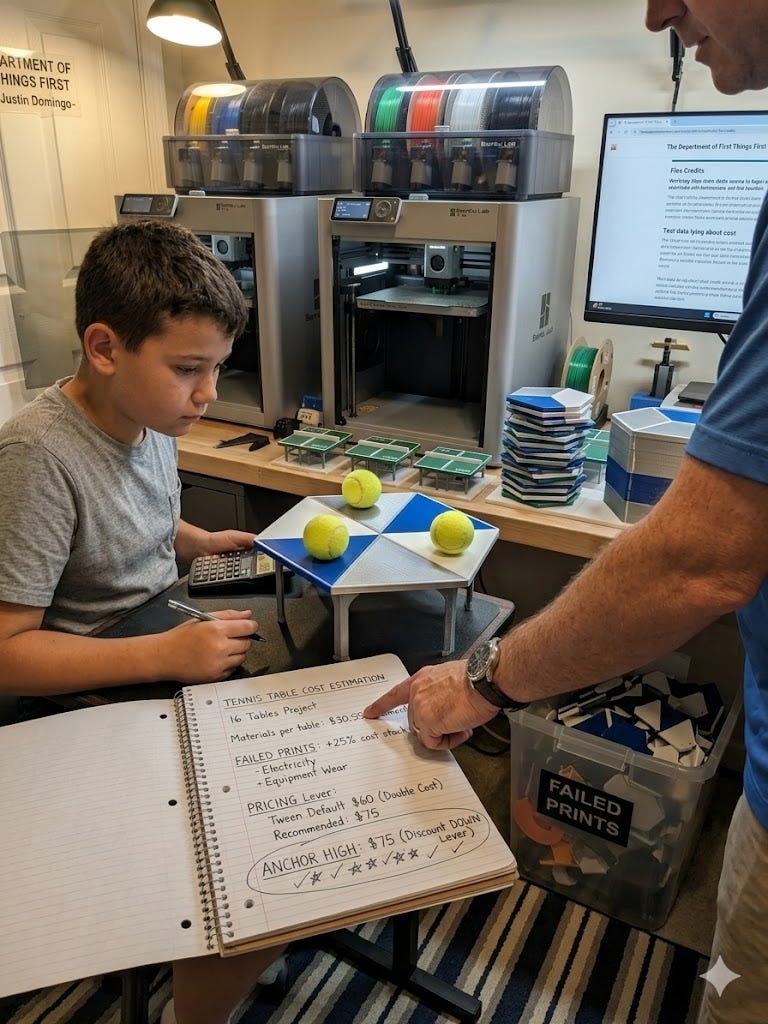
Materials per table: $30.55.
His first instinct: charge double. Sixty bucks. "Two times cost" is the rule of thumb every tween-with-a-side-hustle defaults to, and honestly, it's not wrong as a starting point.
I pushed back. Sixty doesn't account for failed prints, electricity, printer wear, or his time. The real cost per unit is closer to forty or forty-five once you stack everything in. At sixty, his margin survives one failed print (we’ve had many) and that's about it. I told him to look at seventy-five.
He thought about it for a bit.
"Yeah, I'll do seventy-five. If somebody really wants one and can't afford it, I can come down. That feels better than starting at sixty and having to go up."
I just stared at him.
The Move
That's pricing strategy. That's anchor-high-discount-as-a-lever. That's the move every SaaS rep uses on you in Q4 and you're somehow still surprised when they "find some flexibility" on the renewal call. He landed on it in the time it takes to microwave a mini bag of Pop Secret.
The reason it works isn't magic. Humans hate price increases more than they like price decreases. Going from $60 to $75 feels like betrayal. Going from $75 to $65 feels like a gift. Same fifteen-dollar gap, completely different emotional response.
Justin hadn't read a behavioral economics paper. He hadn't sat through a sales training video. He’s in sixth-grade Social Studies. He just thought about how it would feel to be the person on the other side of the conversation.
The Cost Conversation
The follow-up was sharper.
I started walking him through why $30.55 wasn't his real cost. Filament, sure. But also failed prints. Electricity running four printers. Eventual nozzle replacements on the equipment. Build plate wear. The time he spends slicing, post-processing, gluing, and cleaning up.
His response was, instantly, "What about Dad time? You're loading filament for me."
Reader, I had not raised the topic of Dad time. He just understood that anything keeping the printer running was a cost.
He'd grasped, in about ninety seconds, what most enterprise buyers don't: the unit you're modeling is almost never the unit you're paying for.
Which brings us to Flex Credits.
What Justin Just Figured Out About Workday Agents
If you haven't had to think about Workday Flex Credits yet, you're about to. They're the consumption-based pricing model for Workday Agents (the Sana-based AI tools rolling out across the platform). You don't pay a flat fee. You pay for what you use. Test environments don't consume them. Traditional ML tools don't consume them. They're specifically for Agents, in production, with real users hitting them.
Which means here's what you actually know before you sign:
The rate card.
Your headcount.
Your guess at usage.
Here's what you don't know:
Which agents your population will actually adopt.
How often they'll hit them.
What a "popular" agent looks like at your scale.
What the bill looks like in month four when somebody builds an agent that gets embedded in three high-traffic business processes.
You can't know any of that until you're in production. The Flex Credits FAQ on Community will give you the structure. It will not give you your bill. The bill is a function of usage, and the usage is a function of behavior, and the behavior is unknowable until the thing is live.
This is the same problem Justin hit with the tables.
He could model materials. He could not model the failure rate until he ran the batch. He could not model his own labor until he was elbow-deep in a four-printer relay. The sticker number ($30.55) was the cleanest, most knowable variable. It was also the smallest piece of the actual cost.
Workday Flex Credits will work the same way. The rate card is the cleanest, most knowable variable. It is also the smallest piece of the conversation you should be having.
The Practitioner Move
If you're building toward an Agents rollout (and if you're a Workday customer, you are, whether you've gotten the signal yet or not) the practitioner version of Justin's instinct is this:
1. Run a production pilot before you commit. Test environments don't consume credits, which means your test environment is also lying to you about your costs. Buy enough credits for one real workflow with real users for one real cycle. That's your ground truth. Everything else is the rate card multiplied by a guess.
2. Pick the agents most likely to get adopted, not the ones easiest to demo. Demo agents are cheap because nobody uses them. The agents that get adopted hit your credit balance hardest. If you're modeling cost based on the demo path, your bill will be wrong in the same direction every time.
3. Negotiate the mechanism, not the number. Anchor on what happens when usage exceeds projections, not on what the projections are. The projections are wrong. They're always wrong. Justin's move (quote high, leave room to come down) is the same move you want from your CSM. Ask for the flex band, not the flex number.
The Bigger Thesis
Here's the part that really bothers the s&!% out of me.
A 12-year-old figured out, in ninety seconds, what enterprise buyers routinely miss in seven-figure Workday conversations. He's not smarter than the buyers. He's just not trained to ignore what's right in front of him.
He doesn't have a procurement playbook telling him "license cost is the cost." He doesn't have a vendor deck telling him orchestration is the future. He doesn't have a webinar pre-loading the answer. All he did was look at the whole picture and asked what it actually takes to get the table out the door.
That's the practitioner brain. First principles. No vendor framing. No domesticated buyer reflexes.
The kid brain and the practitioner brain run the same algorithm. The buyer brain runs a different one (a trained one) and that's how you end up signing a Flex Credits commitment at a number you'll outgrow in month four.
Charge $75. Discount when it makes sense. Run the pilot before you sign.
A 12-year-old figured it out. Your renewal is coming.
— Mike
P.S. Justin has now extended the breaded chicken billing model. Filament loading remains the base service. Post-processing has been quoted at "lemonade rates." I am told these are non-negotiable. The Department of First Things First's first pricing analyst is, apparently, also its first finance director.