


tldr; The Silver Lake news isn’t the change. It’s the confirmation.
Reuters reported talks, not a deal. ~$43B valuation, no terms, real chance it never closes.
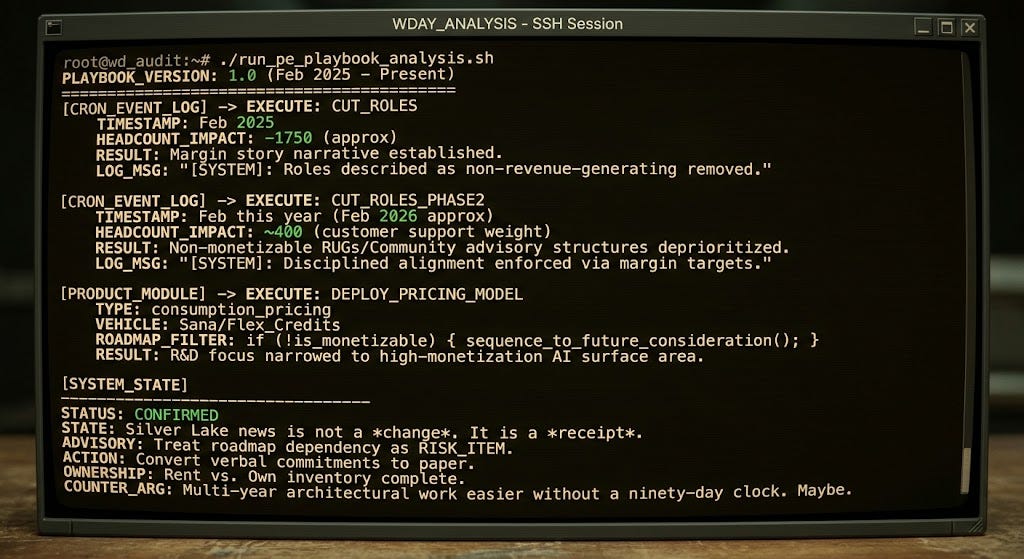
Workday already executed the PE playbook itself: 1,750 cuts in Feb 2025, ~400 more this February weighted toward customer support, consumption pricing via Flex Credits, growth decelerating into a margin story.
Silver Lake wouldn’t arrive to impose discipline. The discipline is already installed. That’s the part worth worrying about.
What a close actually changes for you: roadmap statements lose their accountability, the community layer gets a return threshold it’s never faced, and anything unmonetizable inside the hold window quietly slides.
Do three things now: treat roadmap slides as risk items, convert verbal commitments to paper while pre-close leverage is at its peak, and inventory what you own versus what you rent.
The fair counterargument: the public market has been a bad owner, and architectural work is genuinely easier without a ninety-day clock.
Yesterday afternoon, WDAY got halted.
By the time it reopened it was up double digits (the best single day the stock has ever had) and my phone was doing the thing where three separate practitioner group chats go off at once. Reuters had the story: Silver Lake in talks to take Workday private at something around a $43 billion valuation. Talks. Not a deal. No signed anything.
Within about ninety minutes, LinkedIn had already written the eulogy.
You know the post. You’ve probably drafted a version of it in your head. PE buys software company. PE cuts R&D. PE guts support. PE raises your renewal nine percent and calls it a partnership. It’s a good post. It’s mostly historically defensible.
It is also, in this specific case, about eighteen months late.
Here’s the thing nobody reacting to Thursday wants to sit with. Workday has already been running the private equity playbook. On itself. In public. With a filing requirement.
Count the moves
February 2025: 1,750 roles cut.
February 2026: roughly 400 more, weighted toward customer support and roles described as non-revenue-generating.
Read that phrase again. Non-revenue-generating. That is not SaaS-company language. That is deck language. That is the vocabulary of somebody building a bridge to a margin target.
Flex Credits: consumption pricing bolted onto the AI surface area. Sana. Pipedream. A product story that reorganized itself around one monetizable narrative in about four quarters flat.
Subscription growth decelerating from the high teens toward fourteen percent, with the gap between “growth story” and “profitability story” closed the way that gap always gets closed.
None of that required a sponsor. That was management, reading the same room the sponsor reads.
So when people say Silver Lake is going to come in and cut: cut what, exactly? The support org already took the hit. The consumption model is already installed. The AI-or-nothing product thesis is already the entire roadmap. Silver Lake wouldn’t be arriving to impose discipline. They’d be arriving because the discipline is already there, the multiple compressed anyway, and that is a very attractive combination if you have $43 billion and a ten-year clock.
The scary version isn’t what changes. It’s what doesn’t have to.
That’s the reframe.
We’ve been trained to fear the moment of acquisition (the announcement, the integration memo, the new logo on the support portal). But in situations like this, the damage lands in the two years before the deal, when a public company starts quietly optimizing itself into something buyable.
We watched that happen. Most of us filed a ticket during it.
What a close would actually change is narrower, and worse in a quieter way.
Roadmap commitments stop being commitments. Not because anyone’s lying: Because the disclosure obligations that made a forward-looking statement semi-accountable disappear with the ticker. Everything your AE showed you in a sales cycle becomes, formally, a nice conversation you had.
The unmonetizable stuff gets a review it has never had. The community layer (RUGs, Customer Sharing, the parts of Rising that aren’t a sales motion, the advisory structures) has never been asked to justify itself against a return threshold, because it never had to. Under a sponsor with a hold period, everything gets asked. Community is the easiest line item in the world to defend philosophically and the hardest one to defend in a model.
Anything that can’t monetize inside the hold window dies quietly. Not killed. Deprioritized. Sequenced. Moved to future consideration. You’ll recognize the language when you see it, because you’ve seen it.
What you actually do about it on Monday.
Stop treating roadmap slides as planning inputs. If a project plan of yours has a dependency on functionality that is currently a screenshot from Rising, that dependency is a risk item now. Write it down as one, with an owner and a date.
Get what you were promised onto paper while the leverage is good. Right now Workday needs clean quarters, clean retention, and zero customer noise more than it has in a decade. That is exactly when a renewal conversation goes your way. If you have an ask (pricing protection, a Flex Credits floor, a written delivery commitment) the window is open, and it will not stay open through a close.
Inventory what you own versus what you rent. Every custom integration, every calculated field nobody documented, every Studio job with one person’s name on it. If the vendor relationship gets more transactional, internal capability is the only asset you hold that doesn’t reprice.
Where the doom take is wrong
The “PE ruins everything” version is lazy in one specific way, and I’d rather name it than pretend it isn’t there.
Silver Lake is not a strip-and-flip shop. Dell, EA, Endeavor: those are long-hold, operationally involved bets, not SolarWinds-style margin surgery. And there is a real argument that the public market has been an actively bad owner for Workday: punished it for investing in AI, punished it for decelerating, punished it for not being an AI-native startup that didn’t exist in 2005, and left the stock forty percent off its peak while management did roughly the right things.
Multi-year architectural work is genuinely easier without an earnings call every ninety days. That’s not spin, and if you’ve ever watched a quarter-end kill a good idea inside your own shop, you already know it’s true.
The question isn’t whether private ownership could fund the rebuild. It’s whether it would, or whether it goes where that freedom usually goes.
Based on the last eighteen months, place your bets.
And it might not happen at all
Worth saying plainly, because the internet skipped this part on the way to the eulogy: these are talks. Reuters said talks. A deal at this size, at this valuation, with this much financing to assemble, has a real chance of never happening. Half the takes you read this week will be about an event that never occurs.
But an eighteen percent pop on a rumor is its own data point.
The market just told you what it thinks Workday is worth the moment it stops having to explain itself.
That’s the news.
- Mike.
Director HR Technology | Not an Undertaker
P.S. - If this thing signs before Rising, that conference is going to be the strangest one we’ve had in years. Half the sessions built around a roadmap, half the hallway conversations quietly asking whether the roadmap survives. I’ll be there either way. Come find me, and bring the version of your opinion you wouldn’t post.
I love the balances thoughtful approach you continually take. No dramatics, and just something to consider without the panic. 🧡