


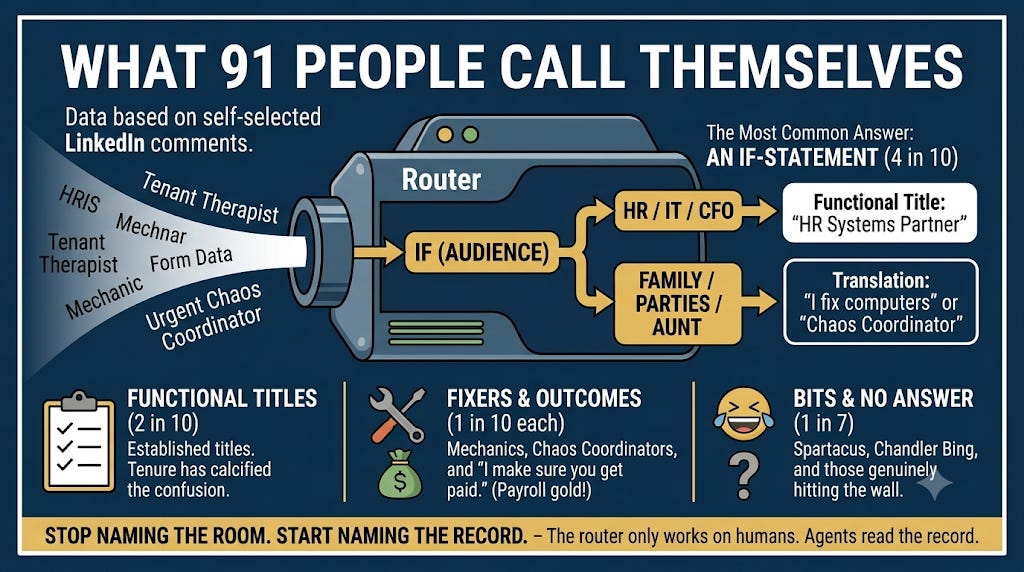
tldr; I counted every answer to “what do you call yourself.” The most common one wasn’t a title. It was an if-statement.
Four in ten gave an audience-conditional answer: “if they’re in HR I say X, if not I say Y”
Two in ten used a straight functional title, mostly the senior folks
One in ten for fixer language, one in ten for payroll-outcome framing
One in seven were pure bit
A handful couldn’t answer at all, and meant it
The router you built works great on humans. It doesn’t work on agents.
Two weeks ago I asked what you call yourself. I expected a laugh and maybe twenty comments.
I got 91, and then I got numbers, which is the part nobody warned me about. Because once you have data, you have to stop telling the funny version of the story and start telling the true one.
So I counted. Here’s what’s actually in there.
The finding I didn’t expect
The single biggest group (call it four in ten of you) didn’t give me a title at all. They gave me a conditional statement.
“If they’re in HR, I say X. If they’re not, I say Y.” Over and over, with the variables swapped: IT for HR, HR for IT, “computers” for family, “accounting” at parties. Amélie Marzin-Germain runs three different answers depending on who’s in the room. Sakshi Vaid Srivastava’s family still thinks she “fixes people’s computers.” Aleefa Shakeel gets it from both directions (IT according to HR, HR according to IT) in the same sentence.
So essentially, you’ve built a small router that takes “audience” as input and returns “acceptable answer” as output, and you run it so fast you don’t notice you’re doing it anymore.
Nobody self-reported this as a system. Everybody described it as an inconvenience.
The rest of the tally
Straight functional titles, stated with no hedge (HRIS Manager, HR Systems Partner, HRIS Systems Strategist) came in around two in ten. I’m guessing these are mostly the senior, established folks. Enough tenure that the confusion has calcified into a title and nobody argues with it anymore.
Fixer language (”the one who fixes it when it breaks,” Aldair Maldonado’s “mechanic you bring the car to”) was about one in ten. Smaller than I expected, given it’s the answer that gets the most reactions when someone says it. High comedy, lower incidence. People love reading it more than they use it.
Payroll-outcome framing (”I make sure you get paid,” Charlie Spitzer’s “I pay people and make sure they don’t die without benefits” pure gold, btw) another one in ten, roughly. This one’s interesting because it’s the only category that skips the org chart entirely and answers in terms of what the person on the other end actually gets. No mention of HR, IT, or Workday. Just the outcome.
Pure bit (no real answer, just the joke) landed around one in seven. Cliff Jurkiewicz went with “I am Spartacus.” (although it was less bit, and more commentary on our profession once you toured his “rabbit hole”). Shawn Latta and Adam Calvert both reached for Friends independently (transponster, Chandler Bing - funny how it all circles around the dude who had a job that no one can name). Sara Ayers gave two: “System Therapist” and “Urgent Chaos Coordinator.” Small, specific note: three different people, unprompted, reached for a therapist metaphor. Diane G., Sara Ayers, and Laura Horton’s “Tenant Therapist” all landed on the same idea from different directions. Make of that what you will. I have thoughts. They’re for a different issue.
And then there’s the smallest group, which is also the most important one. A handful of you didn’t answer the question at all. Paulo Poinha’s response was basically “what am I, actually” (asked in earnest, not as a bit). That’s someone hitting the actual wall the first issue was about, in real time, in a comment box.
What this does to the original argument
The first issue said: we name ourselves after tools or failure modes because we’ve never written down our scope.
The tally sharpens that. The biggest group of you didn’t even get as far as picking a wrong name: you built an audience-detection system instead, and you did it so quietly you don’t count it as an answer. That’s a more sophisticated coping mechanism than “I’m a Workday admin,” and it’s also a more expensive one, because a router has no scope by design. It’s not supposed to have one. It’s built to say whatever gets a nod back.
Here’s the fair complication, and it matters: for a lot of you, the router isn’t a failure: it’s a translation skill you’ve built on purpose, and it’s genuinely useful when you’re the only person in the room who can talk to both HR and IT without an interpreter. I’m not telling you to stop doing it. Codeswitching between departments is a real skill, not a symptom.
The problem isn’t the router. It’s using the router as a substitute for ever writing the scope down anywhere. You can keep three audience-specific answers for cocktail parties and still have one written answer for the org chart. Most of you have the first. Almost none of you have the second.
The one answer the router can’t return
Here’s what bothers me, now that I’ve sat with these numbers for two weeks.
The router works. That’s the problem. It works well enough that nobody in this function has ever been forced to answer the question once, in writing, in a form that holds for every audience.
So let me put a fixed return value on the table, and you can tell me I’m wrong in the comments.
Finance doesn’t run a router. Finance owns the ledger. There’s a book, the book is authoritative, and every downstream number in the company resolves back to it. Nobody asks Finance what they do, because everybody already knows what Finance holds.
We hold one too. Not “HR data.” Not “the tenant.” The authoritative definition of how work is structured: what a job is, what a position is, who reports to whom, when someone becomes a worker and when they stop being one. Every headcount number Finance reports, every dollar payroll moves, every access decision security enforces, resolves back to a record somebody in this function configured.
Same species as Finance’s ledger. Different subject.
And it’s the same sentence in every room. HR, IT, your CFO, your aunt at Thanksgiving. It needs no audience check, which is exactly why your router was never built to return it.
I read a manifesto last month from a services firm. Five points on what this function should become. Point one hands us the AI and agent strategy outright (not IT, not the vendor, us).
Read it twice and the interesting part isn’t the grant. It’s that they had to address it to “HRIS.” A system acronym. People arguing that we should own the most consequential decision in the building, and still no word for the people who’d own it.
They weren’t being careless. There isn’t one.
What I’d do with this Monday
Take the version of your answer you already use with people who understand the domain: not the family-friendly one, the real one. Write it down as a sentence with a verb and an owner: not “I do the Workday thing” but “I own [decision], I configure [system boundary], I’m accountable when [specific failure].”
That’s the sentence from the last issue’s exercise. Turns out most of you already have the raw material for it sitting in your own comment history. You just haven’t been asked to write the serious version down in one place.
Close
Ninety-one (and still counting) answers, and the most common one wasn’t a title. It was an if-statement.
The router is a good piece of engineering. Fast, accurate, and it’s kept this function employable through twenty years of nobody knowing where to file us.
It has one hard limitation. It only runs when a human asks.
Agents don’t ask. They read the record and act on it, at speed, without checking who’s in the room. The thing we never wrote down is about to be consumed by readers who can’t be charmed into a nod.
Stop naming yourself after the room. Start naming yourself after the record.
-Mike
Director HR Technology | Career Actuary
P.S. After I finished counting, I asked Justin what I do for work. No setup, no context. Just asked him at the table.
“You make sure people get paid right.”
One in ten of you gave that answer. He gave it in about two seconds, without checking who was in the room, because nobody’s taught him yet that there’s an org chart to hedge around.
Charlie Spitzer and a seventh grader, same category.
Fixed return value. No router required.