


tl;dr
There’s a war in HR tech nobody names, because naming it means admitting your org chart was designed by a raccoon. It’s the war between the people who buy the talent tech and the people who own it. These are never, under any circumstances, the same people.
TA sees a demo at a conference, has what can only be described as a religious experience, and signs a contract. Then HRIS gets handed the bill, the integration, the security model, and a Tuesday meeting that opens with the three most terrifying words in enterprise software: “so, quick favor…”
The fix is stupidly simple, which is what makes it enraging: put the person who buys it and the person who has to keep it alive in the same room before anyone signs anything. That’s the whole reform. We cannot, as a species, seem to do it.
Let me tell you about the calendar invite.
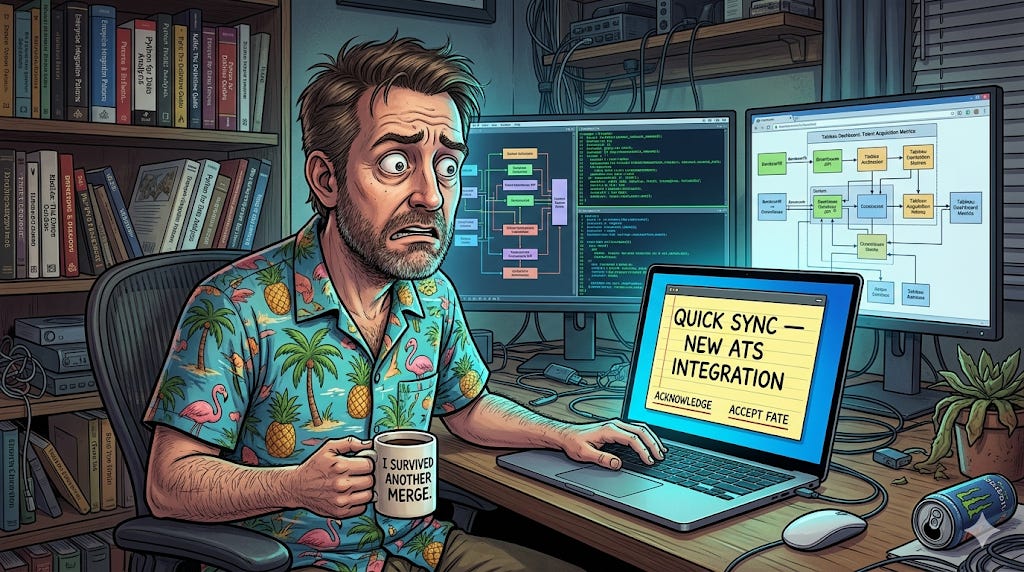
It arrives on a Tuesday, because of course it does. No agenda. No context. Just a title sitting there like a ransom note: “Quick sync — new ATS integration.”
And you, the HRIS person, stare at it. Because you have questions. Questions like: what new ATS? And: integration with WHAT? And, increasingly: am I being fired in this meeting, or worse, given a project?
You join the call. And over the next thirty minutes you learn that three months ago (THREE MONTHS) the talent acquisition team went to a conference. And at this conference, they saw a demo. And the demo was, and I cannot stress this enough, beautiful. Clean data. One radiant, photogenic candidate gliding through a hiring process like a salmon who has never known struggle. And TA gazed upon this demo, and they wept, and they signed a contract.
And nobody told you. Because why would they? You’re just the person who has to make it work.
Welcome to the Boundary Wars. Grab a helmet. (We didn’t budget for helmets. Use a coffee mug.)
Nobody Owns What They Buy (And They’ve Made That YOUR Problem)
Here is the structural insanity at the heart of all of this, and once you see it you cannot unsee it:
In most organizations, the people who buy the talent technology and the people who own the talent technology are completely different humans. Different teams. Different budgets. Different Saturdays.
The recruiting team buys it. I configure it. The recruiting team gets the credit. I get the 2 a.m. alert that says “requisition sync failed” (a phrase that has aged me roughly eleven years and counting).
I am, professionally and spiritually, the poor bastard who has to configure what the TA team buys. That is the most accurate sentence anyone has ever written about my job, and if you work in HRIS, you just felt it in a part of your soul you’d rather not discuss in public.
The Demo. Oh, The Demo.
Let’s talk about the demo, because the demo is where this entire catastrophe begins, and it is a masterpiece of controlled deception.
Every HR tech demo runs on what we in the industry call the “happy path.” This is a magical realm where the data is clean, there are no duplicate person records, every field maps perfectly, and the API has never once gone down at 9 a.m. the morning after a Workday release like a teenager refusing to get out of bed.
It is fiction. It is the software equivalent of a real estate photo shot with a fisheye lens. And TA (who, again, I genuinely do not blame, they are victims here too) looks at this and goes “yes, THAT, I want THAT,” not realizing the demo has the same relationship to their actual tenant that a cruise brochure has to a norovirus outbreak.
And then comes the phrase. The phrase that should be classified as a controlled substance. The two most expensive words in the English language:
“Seamless integration.”
There is no seam in recorded human history that has cost more to sew shut. “Seamless” is the word vendors invented so they would never have to say the true sentence, which is: “you will be doing this part, on a weekend, alone, possibly weeping.”
“It Just Sits On Top of Workday”
My personal favorite, because nothing — NOTHING — just sits on top of Workday. You do not casually rest things on top of Workday. Workday is not a coffee table.
There is a toll. There is always a toll. The field mapping. The security model. And my beloved: the headcount reconciliation, where TA’s shiny new tool insists you have 412 open roles, Workday swears it’s 389, and Finance strolls in with a spreadsheet that says 401 and the unshakeable confidence of a person who has never once been right but has also never once been told.
We call this a “single source of truth.” We have built a single source of three truths. It is Schrödinger’s headcount: simultaneously correct and catastrophically wrong until the precise moment someone opens the report in a board meeting.
Credit and Consequence: A Love Story With No Love In It
Here’s the asymmetry that turns a mild annoyance into an actual war.
TA gets the credit. The candidate-experience metric. The time-to-fill slide. The LinkedIn post with 1,400 likes about “transforming talent acquisition,” shared enthusiastically by people who have never once opened a business process diagram in their lives.
HRIS gets the consequence. The ticket. The Saturday. The release-cycle whack-a-mole where you fix one integration and two more pop up giggling. And the all-time classic: the security group nobody read, configured at speed, that quietly lets a recruiter see executive comp data they were never, ever supposed to see. (In the Department, we have a technical term for this. We call it a Career Limiting Event.)
Same software. Two completely different relationships with it. One of these people is at happy hour. The other is us. On a Saturday. Again.
So Whose Fault Is This? (Plot Twist)
And here is the part where I’m supposed to point at the recruiters and scream. Except (and I need you to really hear this) it is not their fault.
It genuinely is not. The recruiters are getting screamed at by a hiring manager about a req that’s been open for sixty days. Somebody sold them a tool that promised to make the screaming stop. They bought the aspirin. You would too. I would too.
The villain isn’t a person. The villain is the ORG CHART. It’s a buying process specifically engineered so the person who signs the contract and the person who inherits the total cost of ownership are in different departments, different budgets, and — crucially — different Saturdays.
You cannot fix that with a better integration. There is no integration on Earth powerful enough to repair a decision made in a room you weren’t invited to. The fix is letting the person who has to keep the thing alive sit in the room before the ink dries.
That’s it. That’s the reform. Put the buyer and the owner in the same meeting. It costs nothing. It requires no software. And somehow, across the entire profession, we treat it like cold fusion.
The Verdict
So here is where we are.
The Boundary Wars don’t end when TA wins or HRIS wins. They end when somebody — anybody — finally stops treating “buy it” and “own it” as two unrelated jobs performed by two unrelated people who meet for the very first time in a Tuesday calendar invite ominously titled “quick sync.”
Until that glorious day?
I’ll be right here. Configuring the thing you bought. Securing the thing you bought. Reconciling the thing you bought against the two other things you also bought.
On a Saturday.
You’re welcome.
— Mike
Director HR Tech | Legal Guardian of Software I Did Not Conceive
P.S. Justin begged me for me to load a new filament type into the printer last week. “It’ll be easy, Dad. Just load it.” Reader, it was not easy. Three hours. Two clogged nozzles. One full recalibration. Several (ok, many) words I will not be reprinting here, because my mother reads this newsletter. He picked the shiny thing; I owned the integration. The Boundary Wars start young, and they start at home.
The Department of First Things First. For the people who do the work.