


tldr; A portable, user-owned record of verified skills has been built at least four times, including by Workday. It keeps dying, and never for technical reasons. Three things kill it every time: the moat, no trusted signer, and cold start. The only place verification actually took hold is the one place the law removed the choice.
October 2019. Workday Rising. Workday announces the future of hiring: Workday Credentials, and a companion app called WayTo. Individually owned, verifiable credentials. Proof of what you can do, carried from company to company, shared on your terms. Bhusri pitched it on CNBC. They’d acquired an identity startup to build it.
I know, because I downloaded it.
It sat on my phone for about a year. I put things in it. And to be exact about what “things” means, because it matters: one credential, issued by Workday, certifying that I had attended Workday Rising. A digital badge proving I’d been in the room where the wallet was announced.
I tried to add my PMP. The app wasn’t ready for it yet.
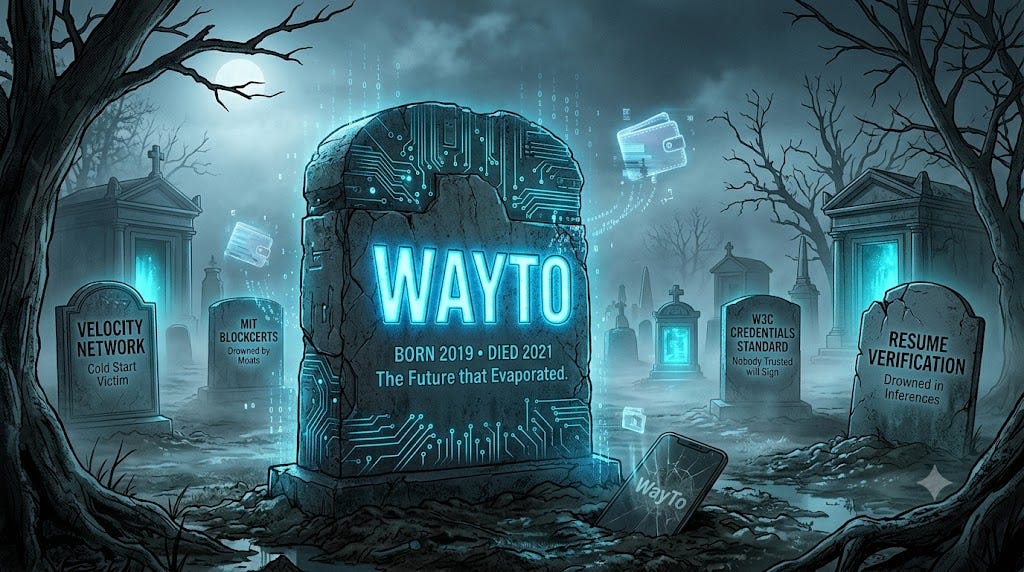
That’s the graveyard in two sentences. A wallet whose only issuer was the company that built the wallet, and no path to load the credential I’d actually earned from an outside body whose entire business is attesting that people can do things.
Then one day it was gone. Not deprecated with a migration path. Not sunset with a notice. Just gone.
And no, this wasn’t a conference demo that evaporated the following Monday. Workday published Terms of Use for WayTo with an effective date in May 2021. Live legal terms, a real product, a design team, a user. I know when it launched, because I was watching. I don’t know when it ended, because nobody said.
It never got a goodbye.
If you have never heard of WayTo, congratulations. You just heard the whole story.
Your best idea has already been built
Every practitioner who stares at the arms race long enough lands on the same design: a portable, user-owned portfolio of verified skills, handed to an employer like a business card. I landed on it years after I’d already been issued one. So did everyone else.
MIT was issuing diplomas on Blockcerts in 2017. The W3C published an open standard for verifiable credentials. Velocity Network, a consortium stacked with names you’d recognize from every expo floor, launched a working mainnet in 2022.
The technology was never the bottleneck. Say that out loud the next time someone tells you we just need better tools.
“It didn’t die, it evolved”
Somebody is already typing that Credentials didn’t fail, it became Skills Cloud. Fair, and it’s the most important distinction in this series.
Skills Cloud infers. It reads your worker data and your job architecture and produces probabilistic skill tags. Genuinely useful for cataloging, internal mobility, workforce planning. I’m not knocking it.
But inferring is not verifying. A probabilistic tag is a guess with good manners.
And here’s why that matters. A candidate uses an LLM to generate keywords. The platform uses ML to extract probabilistic tags. A screening tool matches one probability against the other. That’s algorithmic noise matching algorithmic noise, and everybody gets a confidence score for their trouble.
Inference solved cataloging for the enterprise. It did not solve trust between a candidate and an employer. Different problems. Only one of them is drowning us.
Killer one: the moat
My favorite piece of evidence in this whole saga comes from LinkedIn’s own help documentation.
LinkedIn has a verification badge now. Real infrastructure, built on Entra rails. It verifies three things: that you are who you say, that you work where you say, that you went to school where you say. The docs are explicit about the boundary. Not your title. Not your expertise. Not one claim about what you can do.
They built the rails all the way to the edge of the thing that matters. And stopped.
Now: Follow the money. Talent Solutions, meaning seats and postings and pipeline tools, is the majority of LinkedIn’s revenue, and the moat under it is self-reported profile data plus network effects. Verified portable competence means employers search less, InMail less, buy fewer seats.
The ambiguity is the product. Verifying skills wouldn’t improve it. It would end it.
Indeed runs a different flavor of the same incentive: their model monetizes application volume. The flood drowning your recruiters is somebody’s revenue line.
Neither company is evil. Both are rational. If you read Part 1, you know rational is the problem.
Killer two: nobody trusted will sign
The moat only explains half the graveyard.
Workday had no moat conflict. Their customer is the employer. Portable verified credentials would have made the platform more valuable, not less. Clean incentives, and it still died. So did Velocity, a consortium built specifically so no single vendor could strangle it.
Different killer. A credential is only as strong as whoever signs it, and nobody trusted will sign the claim that matters. Ask a past employer to vouch for how good someone actually was. You’ll get dates and a title, in the flat voice of someone reading a script legal wrote. Because legal wrote it.
Certifications work fine for the certifiable. My (now renewing, but not all of them, that’s another story for another time) Workday Pro certs are verifiable right now, no blockchain required. But look at what they certify: knowledge of a system. The things that actually drive a hire (judgment, architecture instinct, the ability to tell a VP their timeline is fiction without getting escorted out) are the least certifiable things a person has.
The chain can carry any claim securely. The problem is upstream. Nobody credible will make the claim.
Killer three: nobody shows up first
Candidates won’t maintain wallets no employer checks. Employers won’t check wallets no candidate carries. Cryptography has never once solved a chicken-and-egg problem, and it didn’t here.
I was the guy who showed up first. Nobody was on the other side of the room.
The one place it actually works
Velocity isn’t dead, by the way. It found traction.
Guess where?
Healthcare. The one corner of the labor market where verification is mandated by law and every day of delay is a compliance problem and an empty shift. Where regulation removed the choice, the infrastructure works fine. Instantly, even.
So, the technology works everywhere. It gets adopted exactly where the law forces it. That’s an incentives finding, and it’s the whole thesis in one data point.
The defection that pays
So what breaks an equilibrium this stable? Regulation, which is healthcare’s story. A coalition big enough to move together, which is what Velocity tried and the cold start ate. Or defection that pays off individually, which is the hopeful one.
Justin runs a 3D printing business out of our basement. When a customer asks whether he can print something, he doesn’t send a document describing his printing philosophy and core competencies. He shows them the last thing he printed. Twelve years old, and he arrived at proof-of-work hiring on his own, because nobody has taught him the vocabulary that lets adults avoid it.
The research has agreed with him for decades. Work samples and structured interviews sit far above resume screening as predictors of job performance. Resume screening doesn’t crack the top of the list. The instrument we’re all pointing AI at is the least predictive one in the drawer.
One caveat, or I’m just moving the arms race down the funnel: the take-home is already compromised. Candidates finish your case study with the same tools they used on the resume, and they should, because you would. An asynchronous work sample in 2026 is a resume with extra steps.
So when I say work samples, I mean observed. Live, structured. Watching someone reason is the thing AI can’t hand them. The friction is the instrument.
And no, you can’t put 2,000 hourly applicants through a live evaluation. Nobody’s asking you to. The move is directional: shift weight off top-of-funnel resume filtering toward short structured evaluations that actually predict something. Nobody converts a whole pipeline by Q4, and anyone promising that is selling. Weight the proxy a little less each quarter and watch what happens to quality of hire.
Seven years ago the future of hiring was announced on a stage, and it quietly evaporated off my phone while almost nobody noticed. That’s a market telling you, in its own language, what it’s actually optimizing for.
Nobody profitable wants to fix it. Nobody willing to fix it can.
Until one of those sentences changes, the arms race is the roadmap.
-Mike.
Director HR Technology | Undertaker
P.S. — Going to Rising this fall? Ask a longtime Workmate, warmly, whatever happened to WayTo. Then watch their face. I don’t need to ask. I still have the muscle memory of opening an app that isn’t there.
P.P.S. — My friend Doug Barkholz died on August 28th. He was 54.
In my twenties, Doug had every single thing I was fairly sure I was never going to get. Twin little kids. A house that looked enormous to a guy whose furniture was mostly borrowed. Bev, who was the reason the whole operation ran. And he was, irritatingly, the best athlete in whatever room he walked into. Volleyball, tennis, ping-pong, pick a sport, he was better at it than you by the second set.
The way we all ended up in each other's lives is the part I keep telling people this week.
Jenn set the ball. Doug hit it. It hit Bev.
Broke her arm.
That is the actual origin story of one of the most important friendships of my adult life. A good set, a better swing, and an ER visit.
I watched Nathan and Samantha a lot of nights while the three of them played. I didn't think of it as babysitting. I thought of it as the price of admission to a house where people liked each other out loud, which was not something I had a ton of reference points for at the time.
Doug was born Tuan Quang Nguyen, in Vietnam. He got here the way I got where I am, which is to say somebody chose him. Adopted people find each other. Nobody announces it. You just end up in the same kitchen at 3am and something in the wiring recognizes something in the wiring, and five years later you're the guy watching his kids.
His obituary lists his mother and his birth mother in the same sentence, right next to each other. He'd have wanted it that way. Both of them are real. That's the whole thing.
I idolized him. I'm not going to soften that with something more dignified. I was twenty-something and I looked at his life the way you look at a floor plan.
What I understand now, and didn't then, is that he wasn't showing me a life to envy. He was making room in his.
Bev, Nathan, Sammy — you have the whole thing. All of it.
The crew has got you, Doug. Somebody else can set for Bev.