

tldr; The label you use for yourself in meetings, on slides, and in your email signature is not just identity. It’s a funnel for the work that gets routed to you. “The Workday person” attracts tickets. “HR Tech Architect” attracts design sessions. Choose accordingly, and be honest about the cost of choosing wrong.
Tell me what you call yourself in meetings, and I’ll tell you what you’ll be doing for the next eighteen months.
Not your job title. Your label. The phrase you use when someone you don’t know asks “so what do you do?” and you have three seconds to land it.
The phrase you put in your email signature when nobody’s making you. The one you say when someone catches you at a conference and asks what you do.
That phrase is doing more than you think.
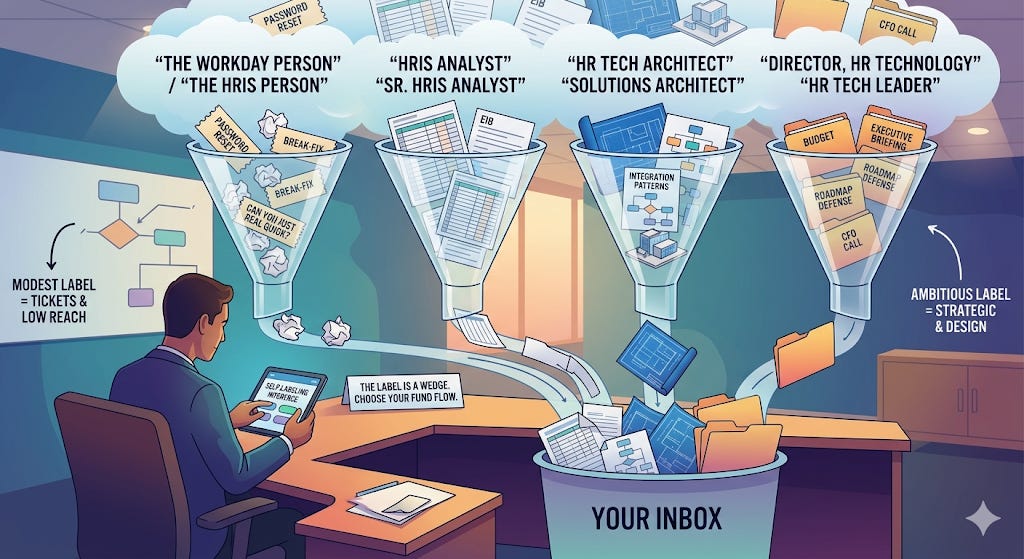
In HR Tech, the labels people use for themselves fall into four buckets. They feel honest. They feel modest. They’re also routing instructions for your inbox.
“The Workday person” / “The HRIS person”
Call yourself this and you’ll get tickets. Break-fix. The “can you just real quick” requests. The password resets that aren’t your job. You will not get a seat at the roadmap conversation. Ever.
“HRIS Analyst” / “Sr. HRIS Analyst”
Configuration projects, requirements gathering, the Friday EIB. Respected as competent. Rarely consulted as strategic. The bench player who never gets called into the strategy huddle.
“HR Tech Architect” / “Solutions Architect”
Design sessions. Integration patterns. Vendor evaluations. The “what should we do about agents?” conversation. You still touch the tenant when something interesting breaks. Mostly you’re drawing the blueprint someone else builds.
“Director, HR Technology” / “HR Tech Leader”
Budget conversations. Executive briefings. Headcount decisions. Vendor relationships. Roadmap defense. The CFO and CHRO calls. You don’t touch the tenant. You traded the keyboard for the calendar. Different rooms entirely.
Which is the whole point.
Each label trades hands-on credibility for strategic reach. Where you sit on that gradient decides which work flows to your desk. Not over years. Over weeks.
Most of my audience is in the modest-label camp. “I’m just the Workday person.” Said with a small shrug. Sometimes with pride.
I get it. I’ve been there. The modesty feels honest because the work is mostly tactical. You actually are the Workday person. Calling yourself anything else feels like cosplay.
But the modest label is a tax. You pay it every time someone forwards you a ticket that should have gone to Tier 1. Every time a VP wants a calc field built and comes to you because you’re “the Workday person.” Every time you’re not in the room when the AI vendor presents because the meeting is for “architects.”
The tax compounds. After three years of “the Workday person,” nobody on the leadership team can picture you doing anything else.
Where most career advice falls apart is that relabeling has a real cost.
Some peers will roll their eyes. Some bosses will think you’re getting above your station. You will go through an awkward period where the title on your email signature doesn’t match what HR has in Workday, and someone will absolutely send a passive-aggressive Teams message about it.
You will also, occasionally, get caught not knowing something an architect or a director “should” know. That moment is brutal. It is also part of the deal.
The label is a wedge. Not a magic wand. It opens the room to grow into. It doesn’t pre-fill the room.
So how do you actually change it?
Not by waiting for the promotion. Promotion follows label. Not the other way around.
Change it in the small places first. Your email signature. Your LinkedIn headline. How you introduce yourself at the next RUG meetup. The “About me” slide on your next deck.
Then change it in the medium places. How you describe your role to a recruiter. How you frame your last project in your one-on-one. How you describe what you do to your kids.
Then watch your inbox over the next ninety days. Different questions. Different cc’s. Different rooms.
Your title is what HR puts on your offer letter. Your label is what you put in your email signature. They don’t have to match. They often shouldn’t.
The work you want is downstream of the label.
Change it on purpose.
— Mike
Director HR Tech | Self-Appointed
The Department of First Things First. For the people who do the work.
P.S. - Justin announced over dinner that he was no longer “a sixth grader.” He’s “a kidpreneur.” I asked what changed. He said, “Nothing yet. But now people will start asking me different questions.”
Smart kid.