


tldr;
Rising is six weeks out, and everything on that expo floor is designed to sit on top of your tenant.
None of the demos were built on your data. The audit is how you know your ground truth before somebody in a branded polo describes it to you.
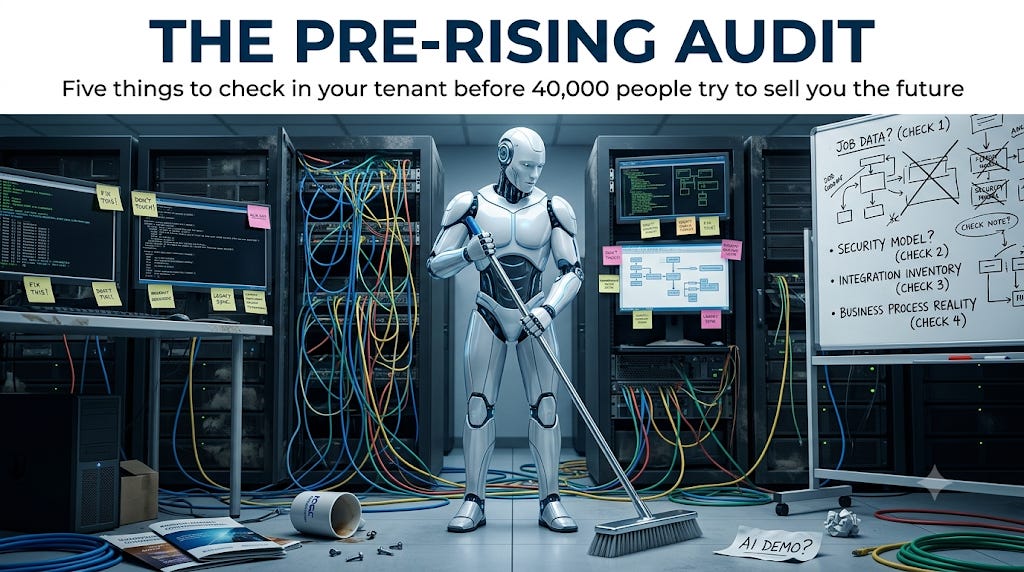
Five checks, about thirty minutes each: job data, security model, integration inventory, business process reality, and the why coverage.
Each check arms you with one question that separates a real product from a happy-path demo.
Half a day now. It’ll be the highest-ROI half day of your conference. I’ll be there; come argue with me.
Six weeks to Rising.
The session catalog is live, your inbox is filling with “will you be in Vegas?” emails from vendors whose products you cannot name, and somewhere a demo team is rehearsing on a tenant so clean it should be in a museum.
Here’s the thing about everything you’re going to see in that expo hall: all of it, every agent, every experience layer, every AI-powered anything, is designed to sit on top of your tenant. And none of it, not one demo, was built on your data.
The gap between those two facts is where implementation hangovers come from.
So before you fly, run the audit. Five checks. Thirty minutes each. The goal is not to fix anything (you won’t, not in six weeks, and that’s fine). The goal is to know your ground truth before someone else describes it to you, because the practitioner who knows their ground truth asks a different kind of question at the booth. The kind demo teams practice avoiding.
Check 1: Pull ten job profiles at random
Not your ten best. Ten random ones. Read them like a candidate would, or like an AI agent will.
When were they last touched? Do they describe the job as it exists, or the job as it existed when someone copied it forward during implementation? Do similar roles use similar language, or did five recruiters invent five dialects?
Why this one’s first: every AI capability you’ll see demoed this year (matching, sourcing, talent summaries, skills inference) runs on this data. The demo runs on curated profiles. Yours will run on whatever you just pulled.
THE BOOTH QUESTION: “Show me what your product does with a job profile that hasn’t been updated in four years. Not a cleaned one. That one is my tenant.”
Check 2: Pick one manager. Enumerate what they can see.
One mid-level manager. Trace their actual access: security groups, role assignments, the reports they can run, the data those reports expose. Not what the security matrix says on paper. What the tenant actually resolves.
If that exercise takes you more than thirty minutes, that’s a finding. If the answer surprises you, that’s a bigger finding.
Why it matters this year specifically: the biggest pitches at Rising are experience layers and universal search. One conversational front door across all your systems. Every one of those pitches is a stress test of your security model, because search surfaces whatever access allows, at scale, without the natural obscurity of nobody-knows-where-to-click.
THE BOOTH QUESTION: “Walk me through what happens when your search layer meets a security group that was misconfigured in 2021 and nobody noticed because the data was three menus deep.”
Check 3: Produce the integration number
How many integrations are running against your tenant right now? Not roughly. The number.
If you can’t produce it, you’re in good company (I have walked into organizations that genuinely could not give me a number), but you can’t orchestrate what you can’t inventory, and you definitely can’t budget for it. While you’re counting, mark which delivered integrations have been modified, because under the current Flex Credits policy language, modification changes how they’re metered. That’s not commentary, that’s just what the contract says now, and every new product you evaluate at Rising drinks from the same wallet.
THE BOOTH QUESTION: “What does your integration actually consume, in whose credits, and what happens to that math when we customize it? Show me the meter, not the diagram.”
Check 4: Count the steps in your three highest-volume BPs
Pick the three business processes that run the most: probably hire, job change, and one of your absence or comp flows. Count the steps. Then mark the ones that exist because of a workaround somebody built in 2019 and everyone has been stepping around ever since.
Why: the agent pitch this year is process automation. An agent can’t optimize a process nobody can accurately describe, and it absolutely will automate your workaround at machine speed if you hand it one. Garbage in, garbage out, but faster.
THE BOOTH QUESTION: “Before your agent optimizes this process, how does it find out that step six only exists because our old payroll vendor couldn’t handle mid-period transfers? Because nobody wrote that down.”
Check 5: Run the why coverage
Last one, and if you’ve been reading this newsletter all summer you saw it coming. Take your most load-bearing configuration (the calc field everything depends on, the condition rule with the weird exclusion, the modified integration from check 3) and ask the Bus Factor question: who else knows why this is the way it is?
If the answer is nobody, write the ledger entry now, from memory, dated and flagged as reconstructed. Four lines. Because here’s what happens after Rising: you come home with proposals. Change lands hardest on tenants where the why is undocumented, and you’re about to propose change.
THE BOOTH QUESTION: This one’s not for the vendor. It’s for you, on the flight home, reading your own notes: “does this proposal survive contact with the tenant I actually have, or the tenant I described in the meeting?”
Half a day
Five checks. Call it half a day, generously. What you get back: a ground truth nobody at Rising can hand-wave past, booth questions that end happy-path demos early, and (the quiet benefit) the beginnings of the case for whatever you actually do want to buy, because “our job data is clean, our security model is verified, and here’s our integration inventory” is how funding conversations start.
Clean your room before you shop for robots. Same religion, conference edition.
And yes: I’ll be at Rising. A couple of rooms, a lot of hallways. Details on exactly where in a few weeks, but if you run this audit and want to argue about what you found, come find me. That’s my favorite genre of conversation.
— Mike
Director HR Tech | Ground Truth Department
P.S. — I found out during the first round of the mixed doubles at Arthur Ashe. Between matches, the DJ played "Jolene." Twenty thousand people who'd come to watch tennis sang and danced to every word, and nobody had to ask them to. That's as good an epitaph as I've ever heard a stadium PA deliver. She gave away more than she ever took, stayed kind for six decades whether anyone was watching or not, and never once made a fan feel small for being one. Rest now Dolly, and thank you.
The Department of First Things First. For the people who do the work.