


Fifty-five of you answered. Nobody agreed.
HRIS person. Workday admin. HR systems analyst. HR Tech. People Systems. Business systems. A few “depends who’s asking.” One of you said “professional translator,” which is the closest anybody got.
Twenty years in, and the most specific work in the building is done by people who can’t finish the sentence “I’m the—”
Here’s what I’ve been chewing on since. This isn’t a branding problem. It’s a scoping problem wearing a branding costume.
Every other function names itself by what it owns
Finance owns the ledger. Legal owns risk. Security owns the perimeter. Ask any of them what they do and you get a noun: a thing they’re accountable for, with a boundary around it.
Now listen to how we do it.
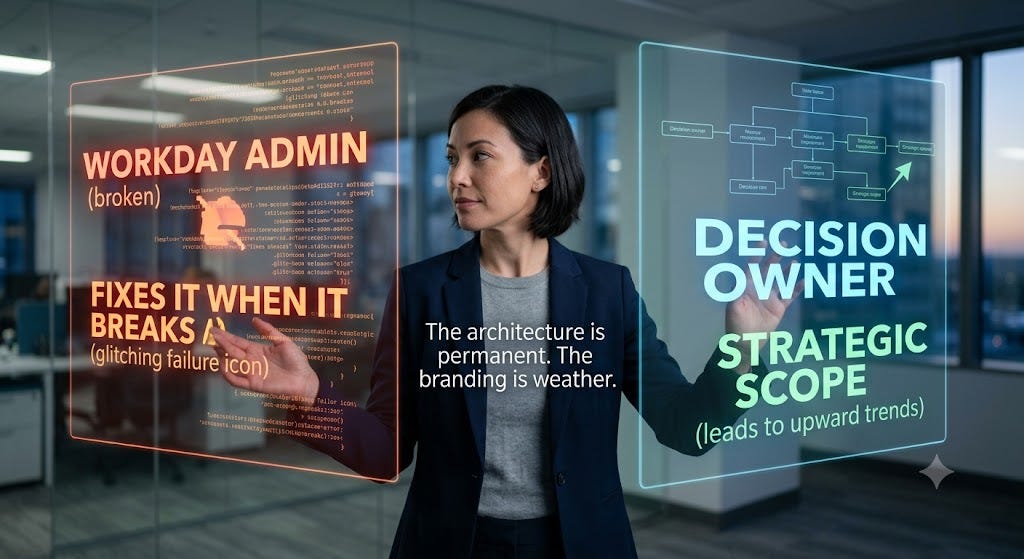
“Workday admin.” Named after a tool.
“HRIS analyst.” Named after a category of tool.
“I’m the one who fixes it when it breaks.” Named after a failure mode.
We name ourselves after the systems we operate or the disasters we absorb. Not one of those is a scope. They’re descriptions of proximity. I am near the thing. When the thing is bad, I am nearer.
The vendor-name trap
If your title is “Workday admin,” your professional identity is leased from someone else’s marketing department.
I’ve said before that vendor branding has a shelf life of about nine months, and I’ll keep saying it. Watch it happen in real time: Illuminate shipped with a naming architecture (Accelerate, Assist, Transform) that got quietly folded into Sana-based branding before most of us finished updating our slide decks. If you’d built your headline around any of those words, you’d be doing maintenance on your own identity right now.
The architecture is permanent. The branding is weather.
That logic runs all the way down to your title. Name yourself after a product and you inherit its release cycle. Name yourself after what you govern and you’re durable across a re-platform, an acquisition, and whatever the next three keynotes decide to call the same four ideas.
“I fix it when it breaks” is the most honest answer and the most expensive one
I love that answer. Every one of us has been that person at 11pm on a payroll weekend.
But it describes a service level, not a scope. And you cannot budget for a service level nobody ever wrote down.
That’s how a team of four ends up holding an entire ecosystem that Finance reads as one line item: because “the Workday thing” has never been described in terms of the decisions it controls. Only in terms of what it costs when it stops.
No name → no scope → no decision rights
This is the part that actually matters, and it’s why I’m not treating a poll about job titles as a bit.
A function with no stated scope doesn’t get decision rights. It gets consulted. There’s a difference, and you’ve felt it: you were in the meeting, you raised the concern, they thanked you, and the decision went the other way. You were the input. Somebody else was the owner.
Then it breaks in month fourteen and you get named after that, too.
Scope isn’t a title. Scope is a written answer to one question: which decisions cannot be made without me, and which ones are not mine to make.
Where the ambiguity is real
Fair concession, this job genuinely spans: Configuration, architecture, vendor management, change strategy, and occasionally light therapy. Any title narrow enough to be precise would be too narrow to be true.
And I know people who’ve worked the fuzziness on purpose. The undefined lane let them grow into finance systems, into analytics, into whole org design conversations that a clean title would have fenced off. That’s not nothing. Ambiguity has a growth setting.
But there’s a difference between choosing ambiguity and inheriting it. Most of us inherited it.
What I’d actually do Monday
Not fix your LinkedIn headline. That’s the cosmetic version.
Write the decision-rights list. One page, two columns. Column one: decisions that require my sign-off. Column two: decisions where I’m an input.
Then take it to your leader and get them to argue with it. Their edits are the whole point: Every line they move from column one to column two is a place you thought you had authority and didn’t. Better to find that out over coffee than in a postmortem.
Do that and the title question gets easy. You stop needing a name for what you touch, because you finally have one for what you hold.
Close
Fifty-five answers and no consensus isn’t a profession without a name.
It’s a profession that’s been describing where it stands instead of what it owns.
Stop naming yourself after the system. Start naming yourself after the decision.