


tl;dr
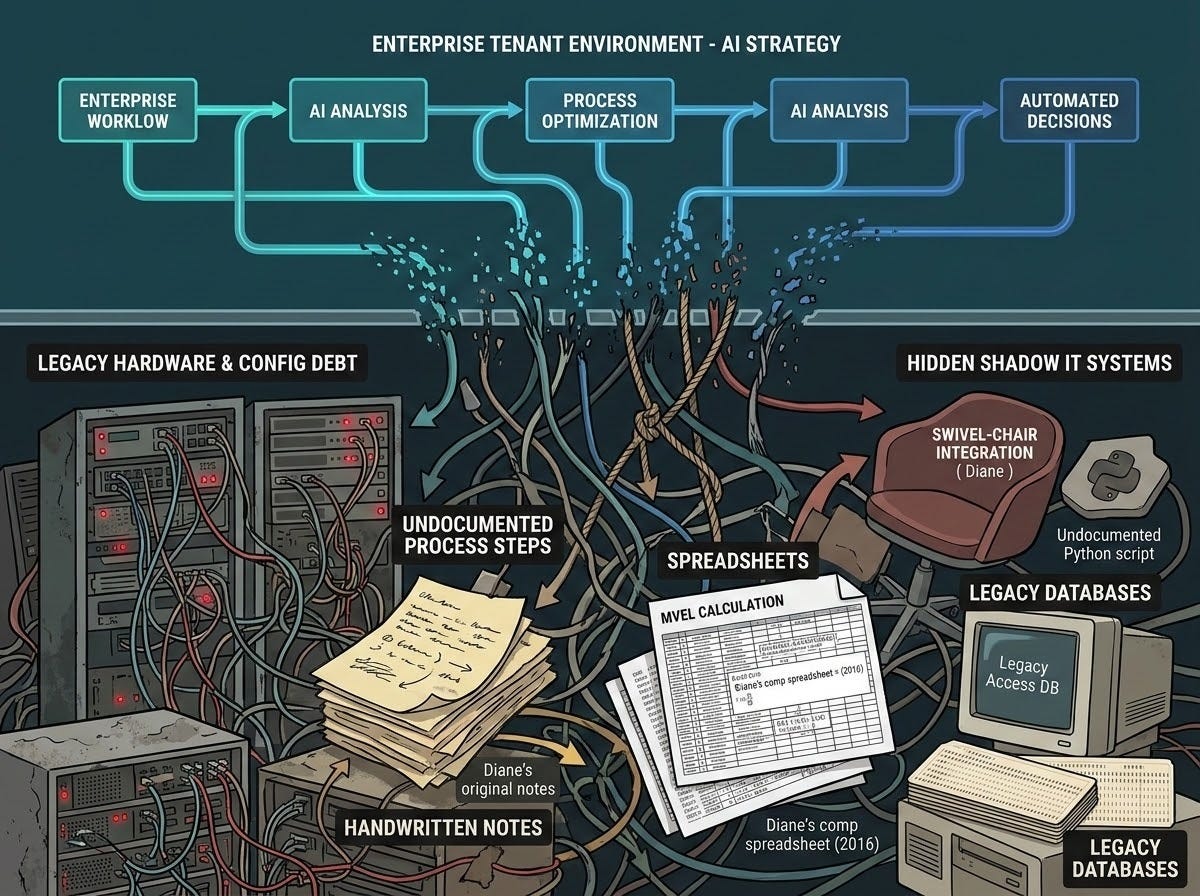
A reader asked me to coin a word. Here it is: Schattenfreude, the slightly guilty pleasure of watching an organization discover that the shadow systems it made you live with for years are now blocking its AI strategy.
McKinsey’s 2025 State of AI survey found that the companies getting value from AI are the ones that redesigned the work. High performers were nearly three times as likely to have redesigned individual workflows.
That’s correct. It’s also what this newsletter has been saying, unpaid, all year.
But the survey measures whether companies redesigned. It can’t see why most attempts die. I can, because they die in the tenant.
You can’t redesign a workflow whose logic was never written down. Every redesign turns into archaeology, and archaeology doesn’t scale.
A couple of weeks ago a reader left a Substack note asking me to do something I’ve wanted to do for about fifteen years.
Coin a word for the joy of watching a company realize the process, data and tech debt it made everyone live with for years is the exact thing now blocking its AI rollout.
Challenge accepted.
Schattenfreude (n.): the quiet, slightly guilty pleasure of watching an organization discover that the shadow systems it made you live with for a decade are now standing between it and its AI strategy.
Schatten is German for shadow. As in shadow HRIS. As in the spreadsheet your comp team actually runs on, the Access database nobody will admit still exists, and the swivel-chair integration that is technically a person named Diane (*my* Diane moved to SC from Jersey, we miss you Di - This is what happens to the Eagles when you move).
It’s one letter away from schadenfreude, which fits, because the feeling is one letter away from pure joy. The missing letter is the moment you realize you’re the one holding the shovel.
This year, Schattenfreude got a consulting logo.
McKinsey found the what
In McKinsey’s 2025 State of AI survey, the organizations getting real value from AI had one trait in common: they redesigned the work. High performers were nearly three times as likely to have fundamentally redesigned individual workflows, and McKinsey called that redesign one of the strongest contributors to business impact of any factor they tested. Brooke Weddle’s organizational work reaches the same place from a different direction: layer agents onto a process nobody rethought and you get the same roles and the same handoffs, just faster.
Then Rising happened, and Workday said it on stage too. According to Incubane’s session summaries, the CHRO keynote’s asks to customers included checking your job architecture and your data first. The vendor selling the agents told the room to clean the room. (I may have made a small noise in my seat.)
Clean your room before you buy the robot is the oldest sermon in this newsletter. It’s nice to have 1,500 organizations and a keynote confirm it.
But the survey found the what, and the what is the easy half. The why is where most of these redesigns are going to die, and a survey can’t see it.
The altitude problem
A survey measures outcomes from above, after the fact. It can tell you who redesigned. It can’t tell you whether the redesign was ever possible.
From 30,000 feet, a workflow is a box-and-arrow diagram. Redesigning it looks like a whiteboard exercise: move the box, redraw the arrow, reassign the role, break for lunch.
From the ground, that same workflow is a business process with a step nobody can explain, feeding a calc field with an exclusion nobody remembers, gated by a security group shaped like a question mark, held together by a change somebody made to a delivered integration in 2019 for a reason that left the company with them.
You can’t redesign that from a whiteboard. You can only redesign it from inside the tenant, and only if the tenant will tell you why it is the way it is. In most organizations, it won’t.
Redesign is archaeology
If you’ve been reading this year, you know the pieces. The Bus Factor: your tenant’s load-bearing logic lives in one person’s head. The Why Ledger: the what is everywhere in your config and the why is nowhere. Twenty People: humans rubber-stamping a recommendation nobody can interrogate.
Now watch all three hit a redesign mandate at once.
An organization decides, correctly, to redesign a workflow around AI instead of bolting an agent on top. First question in the room: why does this process work the way it does today? And for the steps that matter most, the answer is some version of nobody currently employed here knows.
So the redesign stops being design and becomes excavation. The team spends its redesign budget reconstructing reasoning it should have captured in real time. Some give up and automate the workaround, which McKinsey will record as a redesign and which will quietly fail. Some freeze, because changing a rule you can’t explain is scarier than living with a slow one. A few succeed, expensively, on the workflows where the why happened to survive in somebody’s memory.
That’s why the number is three times as likely and not everyone. The real gate is whether the why was ever written down, and no survey question I’ve seen asks it.
The part where I put down the popcorn
Here’s where Schattenfreude gets uncomfortable.
We didn’t just live with those workarounds. A lot of us built them. Under deadline, under orders, sometimes because it was genuinely the right call that week. At a former employer I wrote a geocoding script that quietly became part of how the place ran. Three years after I left, someone called to ask whether it was load-bearing. Nobody inside could answer.
In that story, I am the ancient civilization.
So the debt belongs to all of us. The rooms got messy with everyone in them. What differs is who gets to clean them up, and that part is genuinely good news for us.
Weddle is right that this is core HR discipline: org design, role architecture, workforce planning. But underneath that layer sits one that belongs entirely to the people in the tenant. The layer where somebody knows why the offer routes through comp when the req is flagged remote. Where the reasoning behind the security model is captured along with the model. Where the change to the delivered integration comes with a dated note saying what it was for.
No CHRO can build that from a slide. No agent can reconstruct it, because the config shows the decision and hides the reason. So the redesign era McKinsey just blessed puts our least glamorous work right under the load.
Monday morning
Crawl. Pick one workflow on your AI roadmap. Walk every step and ask why it exists. Count the steps nobody can answer. That count is your real readiness score, and it’s a better number to bring to leadership than any maturity model.
Walk. Every time you reconstruct an answer, write a Why Ledger entry on the spot. Start with the steps the first agent will touch, because that’s where the archaeology bill arrives first.
Run. Make “the why is written down” an entry criterion for any redesign or agent pilot. No ledger, no launch. You’ll get pushback. Point at the McKinsey number and the Rising keynote; for once, the consultants and the vendor are on your side.
The consultants have the altitude, and their map is right. We have the ground. We’re the only ones who know the bridge on the map has been out since 2019 and everybody’s been fording the river on a workaround.
Enjoy the Schattenfreude. You earned it. Then pick up the shovel, because nobody else knows where the bodies are buried.
— Mike
Director HR Tech | Fluent in Schattenfreude
The Department of First Things First. For the people who do the work.
P.S. Club volleyball season is back, and with it my favorite rule in sports: the rotation error. You can lose a point without ever touching the ball, just because you were standing in the wrong spot when the play started. Nobody redesigned the play. The ref just wrote down where everyone was supposed to stand.
I can't hit share fast enough!