


tldr;
The CEO of OpenAI says the singularity is here. I asked an AI, and it disagreed. So does my seventh grader.
Transformation never arrives as a rupture. It arrives as Tuesdays that accumulate (see: 33 years from Dr. Sbaitso to now, and the entire cloud era).
Anyone selling you a "moment" is selling. The honest question isn't "when does it arrive," it's "what does this touch."
Your governance backlog isn't competing with your AI strategy. It is your AI strategy.
Homework for the quarter: run one AI feature in sandbox, break it on purpose, write down where it broke.
On Saturday, the CEO of OpenAI announced that humanity has entered the singularity.
He said this on a podcast, which feels right. The most consequential threshold in human history, the moment machines surpass their makers, revealed between ad reads.
So I did the obvious thing. I asked an AI whether it was true.
It said no.
Not a hedge. Not a "well, it depends on your definition." It told me (and I'm paraphrasing only slightly) that it can't improve itself, can't remember yesterday without a filing system bolted to its side, and that there's an entire building full of humans employed specifically to keep it pointed in the right direction. Its exact framing was "that's a powerful tool, not an event horizon."
The machine was more skeptical of the machine than the man selling the machine. Which is a bit like your realtor telling you the house is overpriced. You should probably listen, because that opinion is working against its own interests.
And yes, this was a real conversation. I did not invent a sassy robot for narrative convenience. (The robot came pre-sassed.)
The 33-year "moment"
My problem with singularity talk isn't that the technology is unimpressive. It's very impressive. My problem is the shape of the claim.
The singularity is a rupture story. A before and an after. One day the machines can't, the next day they can, and everything downstream is unrecognizable. It's a great structure for a movie trailer and a terrible description of how technology has ever actually arrived.
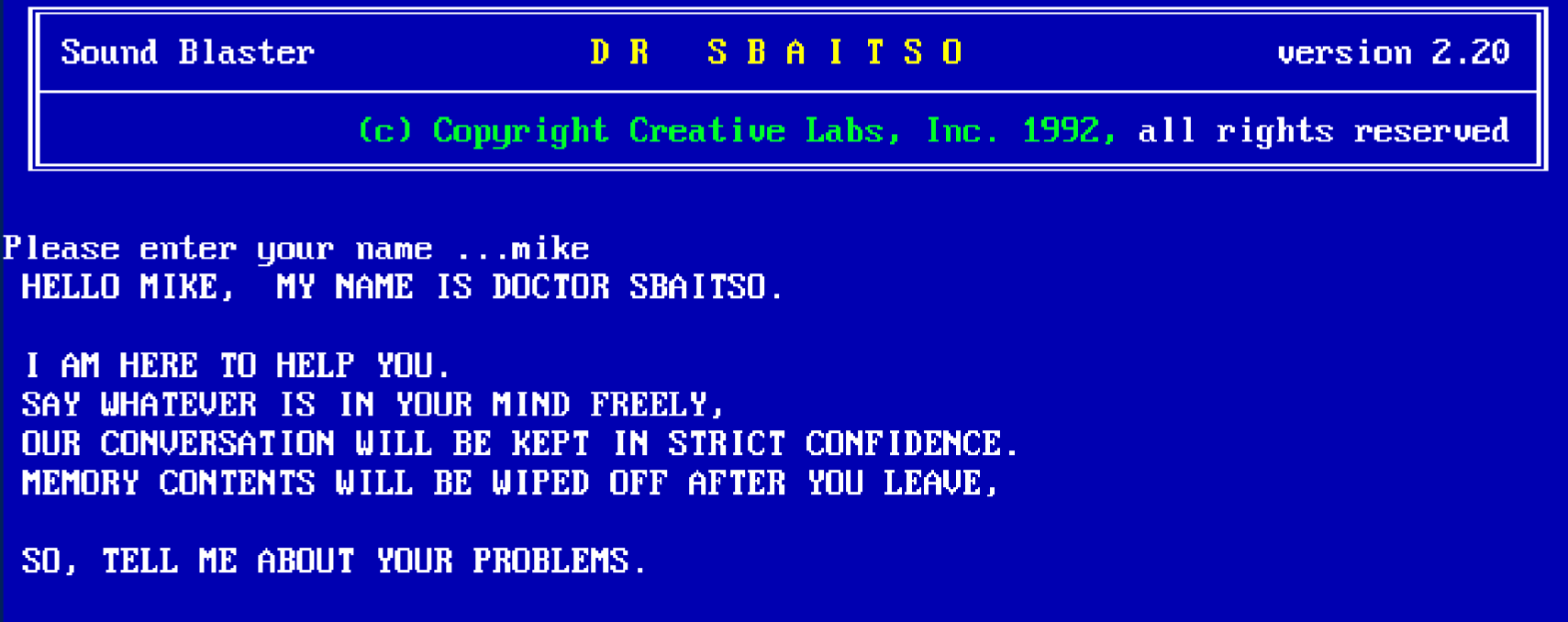
I know this because I've been watching this particular movie since the opening credits. In the early '90s I installed a Sound Blaster card, and bundled with it came a program called Dr. Sbaitso, a "psychologist" that talked in a flat robot voice and mostly repeated your own words back as questions. ("WHY DO YOU FEEL THAT WAY.") If you cursed at it enough, it threw a parity error and rebooted. I ran that experiment. Repeatedly. For science (Quick aside: Yes, I know ELIZA was first).
(Full disclosure: when I brought this up with the AI, I called it "Dr. Sebago." The AI corrected me, then observed that Dr. Sebago sounds like Dr. Sbaitso retired to Maine to sell boat shoes. So, let's review: The program from 1992 could not remember the sentence I had just typed. The program from 2026 fact-checked a memory I'd been mangling for three decades and roasted me about deck footwear in the same reply. That's the curve. I am living on it, and apparently so is my dignity.)
Dr. Sbaitso to the thing that argued with me this weekend is roughly 33 years. The jump is staggering. But notice what it wasn't: a moment. There was no rupture, no threshold, no day the sirens went off. There was a long, boring grind of incremental progress that only looks like magic when you compress three decades into a before-and-after slide.
There was no lunch table moment. There was just Tuesday. Over and over. For thirty-three years.
The kid who never said wow
Here's the part that actually convinced me, and it happened in my own kitchen.
I mentioned to Justin (12, seventh grade, currently running a 3D printing operation out of my basement with the margins of a small cartel) that the CEO of OpenAI says we've entered the singularity.
He looked up from slicing a print file and said, "What's a singularity?"
I explained. Machines smarter than people. The future becoming unpredictable. The thing every sci-fi movie warned us about.
He shrugged and said, "Isn't that just... what AI does?" And went back to his print file.
That shrug is the whole argument. Justin has used AI for homework help since he was ten. To him it's an appliance, somewhere between the microwave and the label maker in the household hierarchy of marvels. The rupture story requires a before, and Justin doesn't have one. You cannot sell "the moment everything changed" to someone for whom it was always Tuesday.
The singularity, it turns out, is a nostalgia product. It's only for sale to people old enough to remember cursing at Dr. Sbaitso.
You've already lived this movie
And if you work in the Workday ecosystem, you've lived it twice, because you remember when "the cloud" was going to be a moment.
Remember that? The revolution. The rupture…The day on-prem died… Bueller? Bueller?
What it actually was: a decade of migrations. Tenant by tenant, integration by integration, one white-knuckle cutover weekend at a time. The cloud revolution absolutely happened, and not one person who lived through it can point to the day. It arrived as a thousand Saturdays in a conference room with cold pizza, and by the time the analysts declared it complete, you'd been living in it for years.
AI in your tenant will arrive exactly the same way. No singularity release. No Monday morning where the platform has transcended. A feature here, an agent there, a capability quietly folded into a business process you already own. Tuesdays. Accumulating.
Which means the rupture framing isn't just wrong, it's operationally wrong. It trains you to wait for an announcement that will never come, instead of managing a curve you are already standing on.
What the curve means on Monday
Three things, practically.
One: anyone selling you a moment is selling. When a roadmap slide promises transformation as an event (a version, a launch date, a keynote reveal with dramatic lighting), that's a marketing shape, not a technology shape. The honest question is never "when does it arrive." It's "what does this touch." Which data. Which security groups. Which business processes. Moments are for stages. Curves are for architects.
Two: the boring stuff is the AI strategy. Every AI capability that lands in your tenant lands on something. Your data quality. Your security model. Your business process hygiene. Ship an AI feature into a tenant where the supervisory org is held together with duct tape and wishful thinking, and you will get duct-tape-and-wishful-thinking answers, delivered confidently and at scale. Your unglamorous governance backlog is not competing with your AI strategy. It is your AI strategy.
Three: gradual doesn't mean ignorable. The trap on the other side. Because there's no rupture, it's tempting to conclude nothing is happening. But 33 years of Tuesdays turned Dr. Sbaitso into something I genuinely can't fully explain, and the people who dismissed the curve in 2023 are already explaining gaps in their resumes. Pick one concrete thing this quarter. Run an AI feature in sandbox. Break it on purpose. Write down where it broke. That's the whole assignment.
Where Altman has a point
Fairness requires this: he's not entirely wrong. He's wrong about the shape.
The compounding is real. And here's the uncomfortable part. Me, spending a Saturday casually debating philosophy with a machine and losing on points? That would have sounded exactly like the singularity to 1994 me, sitting in front of Dr. Sbaitso, waiting for the parity error.
The goalposts move because the middle of a curve never feels like the middle. Every generation of "wow" becomes table stakes in about eighteen months, and then we forget we ever said wow. Altman is looking at that curve and calling it a moment. I get the temptation. It's just not how anyone will actually experience it.
We'll experience it the way Justin already does. As an appliance. As a Tuesday.
The close
So no, the singularity has not arrived, and you don't have to take my word for it. Take the AI's. (Or my seventh grader's. They agree, which should terrify Sam Altman more than anything.)
But something is arriving, at the speed it always arrives: gradually, unevenly, and directly on top of whatever foundation you've built.
The singularity won't be announced on a podcast. It'll show up in your tenant on a Tuesday, disguised as a feature release. Be ready for that one.
— Mike
Director HR Technology | Still looking for the parity error
P.S. Yes, I went looking for a working copy of Dr. Sbaitso, because journalism. It's on the Internet Archive, running in a browser-based DOS emulator, which means a 1992 chatbot is currently enjoying better uptime than several enterprise systems I could name. I asked it about the singularity. It asked me why I feel that way. Thirty-three years on, still undefeated.
The Department of First Things First. For the people who do the work.