


tl;dr: Gartner's Trend #1 for 2026 is AI-Native Development, and the industry buzzword is "Vibe Coding." In Workday-land, that means business analysts prompting apps into existence via Extend and the AI App Builder. The apps work on Tuesday. They break three weeks later, and nobody on the team can debug what the AI wrote. Architecture is the why. Vibes are the what. You need both, in that order.
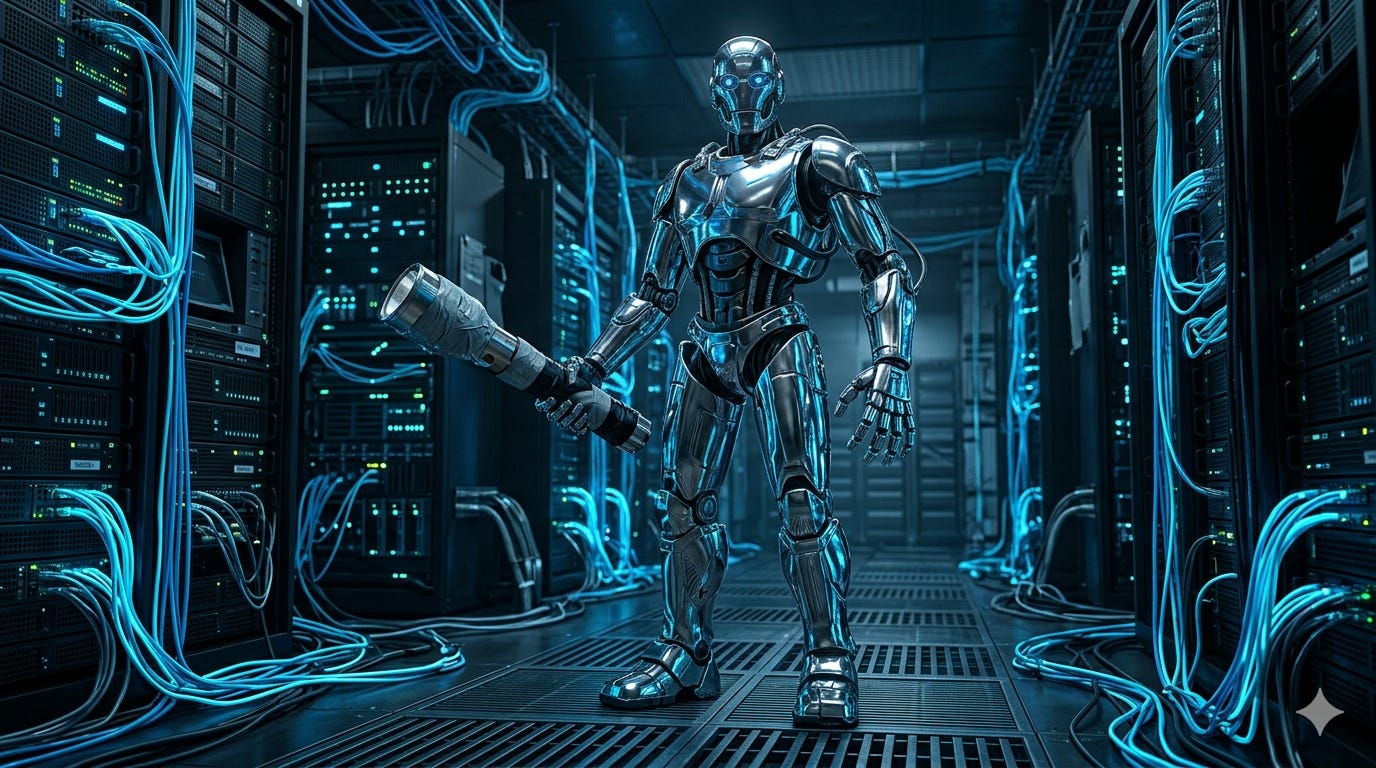
My son Justin is now 12 🥳, and he loves AI image generators (especially Meshy). He'll type in a prompt for a "cool space robot," and the model produces something that looks awesome at first glance.
Then he looks closer.
The robot has seven fingers. Its right foot is actually another left foot. The lightsaber is a flashlight with a ribbon on it.
Justin wants to fix it. But he can't actually draw. Not a robot, anyway. He only knows how to regenerate. So he hits the button and hopes the next version is better. Usually it just has different problems. A missing arm. Eyes pointing in opposite directions. A dragon with three nostrils (don't ask).
Keep that image in your head for a minute, because Gartner just put it on the front page of its 2026 Top Strategic Technology Trends.
Enter the Vibe
Gartner's Trend #1 for 2026 is AI-Native Development, and the buzzword the analysts are rallying around is "Vibe Coding."
The pitch: generative AI has gotten so good at producing software that we don't need to write code anymore. You describe what you want, and the machine vibes it into existence. No syntax. No semicolons. No deep technical knowledge required.
Analysts love this. It's clean, it's democratizing, it fits on a slide. And in the Workday ecosystem specifically, it's about to cause a massive architectural mess.
The Build-vs-Buy Plot Twist
Remember when we all agreed we bought Workday specifically so we wouldn't have to build anything? Yeah. Gartner thinks that's over.
The prediction: by 2030, 40% of enterprise application portfolios will be custom-built on AI-native platforms, shifting the build-vs-buy equation back toward building. In Workday-land, that looks like a Tuesday.
It's a Tuesday. A smart, ambitious business analyst, fluent in PowerPoint and light on XpressO, opens Workday Extend and the new AI App Builder. Her VP wants a "quick app" to track something the core product doesn't handle. A specialized leave type, maybe. Or a contingent worker checklist. Or a talent mobility micro-workflow/survey.
She types a prompt. The App Builder thinks for a minute. Then, magic. An app appears. Fields. Business process. A condition rule. A notification. She clicks through it. It works.
She demos it Thursday. Her VP is thrilled. Her VP's VP is thrilled. Someone uses "citizen developer" unironically. She gets a spot bonus.
Three weeks later, the hyperdrive engine falls off the space robot.
The Seven-Fingered Robot in Your Tenant
The app breaks because somebody rolled out a new supervisory org the condition rule didn't understand (because it hardcoded the org list). Or a condition rule upstream changed. Or the custom object's reference id got renamed during a data cleanup (this one makes me crazy). Or the vibed calculated field worked in the sandbox but stopped working after the next weekly service update.
Pick one. Doesn't matter. Something always changes in a Workday tenant. That's the whole job.
Here's the problem. The BA didn't write the app. She prompted it. She doesn't know which calculated field is doing the lookup. She doesn't know why the condition rule fires in that specific order. She doesn't know what the custom object's security profile inherits from. She can't debug it, because there's nothing in her head to debug from. The code doesn't exist in her brain. It exists only on the screen.
So she does the only thing she can do. She goes back to the App Builder and types: "Fix the app."
The App Builder cheerfully produces new code. Sometimes it works. Sometimes it breaks something else. Sometimes it silently changes the behavior in a way nobody notices until the quarterly audit.
Regenerate. Hope. Repeat.
That's Justin with the robot. Except now Justin is in production, and the robot has access to your worker data.
Extend Isn't a Toy
Here's the part I want every HR tech leader reading this to seriously sit with for a second:
Workday Extend is not a low-code platform with an AI wrapper. It's a full development environment that happens to have an AI wrapper.
That distinction matters. Low-code platforms have guardrails. They constrain what you can do so the blast radius stays small. Extend doesn't work that way. Extend gives you access to the core Workday object model. Custom objects. Calculated fields. Business processes. Integration endpoints. Security groups.
If you vibe a website, the CSS looks weird. If you vibe a Workday app, you might accidentally create a security group that leaks your CEO's home address.
And it gets worse. Gartner also predicts that 80% of organizations will evolve their engineering teams into smaller, AI-augmented teams by 2030. Translation: fewer humans, more vibes. Which sounds efficient until the BA who prompted the app leaves the company, and the three admins remaining on the team have never seen the code, never seen the spec, and can't tell you why the condition rule fires the way it does.
That's not a tiny team. That's an accountability gap with a headcount rationalization on top.
What to Do (Because I'm Not a Luddite)
I'm not saying don't use the AI App Builder. Do it. I’m doing it too (Want proof? Check my GitHub). I'm saying use it the way senior developers use GitHub Copilot: as a drafting tool, not an authoring tool. The draft is free. The review is the job.
Gartner's own 2026 action plan gets this mostly right. Three moves worth stealing:
Establish a platform team. Centralized oversight. Standards. Governance. Somebody who can say "no, that's not how we do it here" without getting called change-resistant.
Implement real guardrails. Code review. Compliance checks. Security profile audits. Don't let an app ship to production just because it passed the "does it run in the sandbox" test.
Adopt an AI-first mindset, not a vibes-only mindset. Accelerate delivery, yes. But only after your team understands the architecture the AI is generating on their behalf.
I'd add one more, Workday-specific: every vibed app needs a named human owner in your Extend inventory. When the app breaks during the next release cycle, you know who gets paged. "The AI built it" is not a name on a support ticket.
The Bottom Line
Vibe coding isn't democratization. It's delegation without accountability.
Architecture is the why. Vibes are the what. You need both, in that order, or you're just prompting your way into a postmortem.
Justin has figured out that the generator isn't going to get the robot right on its own. He's started asking me to help him fix the fingers.
Your business analysts will figure that out too. The only question is whether they do it before or after the app ships during Open Enrollment.
— Mike