


tldr;
A team of senior ex-Workday leaders (former EVP of Products, former CTO, former chief technology architect, former CISO) launched an AI-native HR system called Sol.
The pitch: replace your HRIS. Not extend it. Replace it. First customers go live in early 2027, so there's no product to kick the tires on yet.
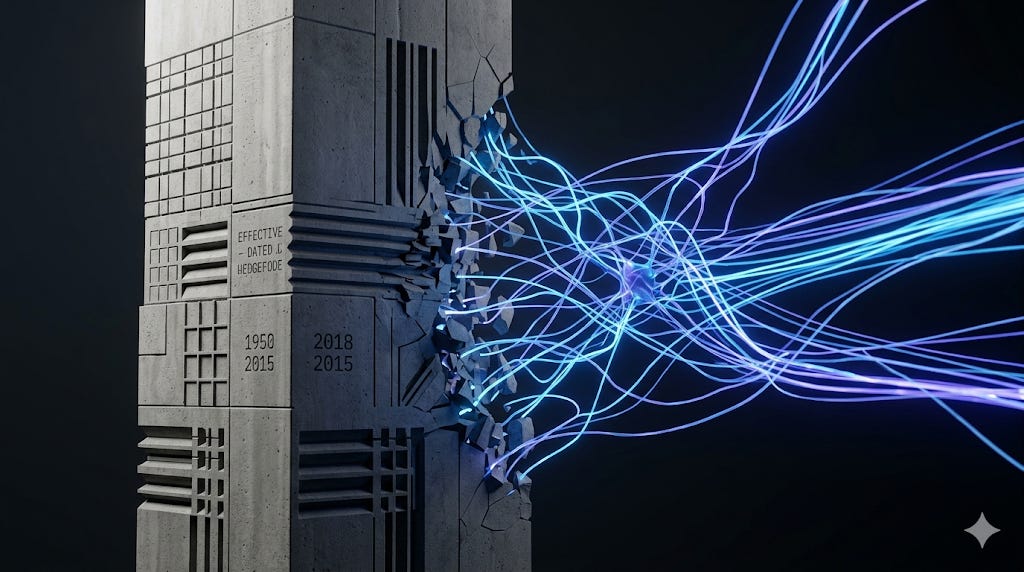
The interesting part isn't the company. It's that the people who designed Workday's foundation are now betting the foundation is the wrong shape for agentic work.
Workday's position is the opposite: extend the core, don't burn it down. Both camps are made of people who built the same system.
What you do on Tuesday: nothing dramatic. Treat it as a forcing question for the foundation you already run.
A few months ago our tennis club owner asked Justin to 3D print a locker for the new Tennixx ball machine. Sounds simple.
It wasn't.
The thing had to survive getting knocked around courtside, and it had to print in less than geological time. Those two goals fight each other. Strong wants thick walls and a lot of material. Printable wants thin and fast.
So he iterated. Five prototypes in OpenSCAD, each one printed, each one tested, each one wrong in a new way until it wasn't. Prototype five prints in a reasonable window and you can drop-kick it. (We tested that. For science. 😅)
Here's what that project taught him, and re-taught me. You don't find out whether a design holds by looking at it. You find out when you knock it around.
I thought about those five prototypes when a company called Sol showed up in my LinkedIn feed (thanks Dana! BTW - just spent a weekend in Niagara. Canada gets two thumbs up from me!)
Not because it's another HR startup. Because of who built it.
Sol was founded by Pete Schlampp, Jim Stratton, Jon Ruggiero, and Erin Yang. If those names don't mean anything to you, let me translate:
Schlampp ran Products and Strategy at Workday. Stratton was Workday's CTO. Ruggiero spent fifteen years there as SVP and chief technology architect. Yang spent thirteen years there, including running technology investing at Workday Ventures. Their CISO, Josh DeFigueiredo, was Workday's CISO. Their "Chief Work Officer" title is a phrase Workday itself coined.
These are not founder randos with a Figma file and a dream. This is the product and architecture brain trust of the system most of you log into every morning. They know exactly where every body is buried in that object model, because they buried some of them.
And the homepage they put their names on says this: "Work changed. Your HR system didn't."
That's the strength problem, scaled to the enterprise. They looked at the foundation they built, decided it won't survive the load that's coming, and walked off to design a new one.
Here's the actual claim, stripped of the launch copy:
Sol's argument is that HR systems capture transactions, not how work gets done. Read that as a builder, not a buyer. Your HRIS is, at its core, an effective-dated record of state changes. Hire. Promote. Transfer. Terminate. A worker object, a position, a sup org, a business process that moves a transaction from A to B. It's a very good foundation for what it was built to do.
The bet Sol is making: agents don't live in that world. An agent doesn't fire a discrete staffing event and go quiet. It needs continuous context. Who's doing what, with whom, right now, and why. The model that's brilliant at recording that someone changed jobs on the 1st is not the same model that captures how the work itself flows. One is a ledger, the other a nervous system.
An HR Executive piece in April put it well: every HRIS built in the last four decades was designed around a single concept, the employment relationship. None of them were built to track a workforce that now includes things that aren't employees at all.
If you've ever tried to make your tenant represent something it wasn't designed to represent, you already feel this, everyday.
The part where I refuse to let this be a press release with my name on it.
Workday is not sitting still, and they do not agree. Their bet is that you extend the core, you don't replace it. Agent System of Record went GA earlier this year. Sana is quickly iterating (so quickly in fact, it's hard to keep up with the changes). Extend and Orchestrate let you build on the same security and business-process spine. The bull case, argued most clearly by Josh Bersin, is that you unlock the data, the security, and the rules you already have, and let agents ride on that foundation.
So this is not a startup versus an incumbent. This is a real architectural disagreement between two groups of people who built the same system, looking at the same problem, and reaching opposite conclusions about whether the foundation survives the transition.
One group says the object model is the moat. The other group left to bet it's the anchor.
That's a way better story than "cool new vendor.”
My read, for whatever a practitioner's read is worth:
Sol's critique bites in exactly the places you already curse at. The moments where your tenant fights you because work went fluid and the model wants a clean transaction. Dotted-line everything. People doing three (or in some cases 30) roles. Project work that doesn't map to a position. Anyone who's tried to model real organizational life in a system built on the employment relationship knows the foundation has opinions, and they aren't always your opinions.
Where it's overblown: four decades of payroll, compliance, audit, security, and integration plumbing do not evaporate because a homepage says "agentic foundation." That plumbing is boring and load-bearing and it's the real reason ripping out an HRIS is a multi-year root canal. "AI-native from the ground up" is a beautiful sentence. It's also, right now, a sentence. There is no product until 2027.
Which is the thing I keep coming back to in this newsletter. "Agentic foundation" is a claim. It's not an architecture until someone shows you the data model. Branding has a shelf life of about nine months. The model is permanent. Read the model, not the logo.
So what do you do with this on Tuesday morning, when you have a tenant to run and a config backlog that does not care about Silicon Valley?
Nothing dramatic. You don't rip anything out for a product that doesn't exist yet. Anyone telling you to is selling something.
But you let it do one useful thing. You let it become a forcing question for the foundation you already run.
Go ask your current platform the questions Sol is implicitly asking. Can it register an agent as a real entity in the system, not a footnote? When an agent takes an action inside a process, does it land in the record itself, where you and Legal can see it, or in some side analytics tool? Can you scope and revoke what an agent is allowed to touch without filing an IT ticket and waiting a sprint?
If you've been reading this thing for a while, you know I already planted this flag. Sol just turned that argument into a funded company run by the people who'd know.
Here's where I land.
As a product, Sol is easy to ignore for now. No GA, no number, no tenant to break.
As a signal, it's the opposite of ignorable. The people who poured the foundation walked across the street and started selling rebuilds. You can disagree with them. Workday clearly does. But you can't wave them off, because they know the load limits of the thing you're standing on.
Prototype five won because Justin stopped trusting the render and started kicking it.
The question this launch puts on your desk isn't "should I buy Sol." It's whether you can say, with a straight face, that your foundation survives the load that's coming, or whether you just like how it looks in the render.
You find that out by loading it. Not by admiring it.
That's the whole job.
—Mike.
P.S. — Prototype five has been at the club a few days now, while we wait for filament to come for the “real build” (logo included, of course). The ball machine lives in it. It gets kicked, dropped, leaned on, ignored. Prototype five does not care. Justin who is now at the club more than me due to summer camp, checks daily to see whether anyone's broken it yet. Nobody has. He's twelve, and he already gets the thing half the vendors in my inbox don't: you don't get to call it done until the real world has had a real chance to wreck it. The rest of us are still working on that one.