


Welcome to January.
The air is crisp. The budget (hopefully) is approved. And across the corporate world, HR Tech leaders are engaging in our favorite annual ritual of self-deception: The Presentation of the PowerPoint Roadmap.
You know the scene. You stand in front of your stakeholders with a beautiful, 16:9 slide deck. It is a work of art. It has chevrons pointing aggressively to the right. It has milestones marked with little diamond icons. It has a timeline that stretches all the way to December with comforting, predictable blue bars.
Q1: Implement Advanced Comp.
Q2: Redesign the Career Site.
Q3: Relax and drink piña coladas while the system runs itself.
Everyone nods. The CIO smiles. The CHRO takes a picture of the slide. You feel strategic.
There is just one problem: That slide is a lie.
By February 14th - that PowerPoint deck will be dead.
It will be killed by an acquisition nobody told you about. It will be strangled by a “Critical P1” issue in Payroll. Or it will be quietly suffocated because the stakeholder who demanded the Career Site redesign watched a TikTok about AI and decided they want a “Copilot” instead.
In the Department of First Things First, we need to stop pretending that we can predict the future on a static slide. We need to stop building Fairy Tales and start building Portfolios.
The Villain: The PowerPoint Deck
The critique I hear most often about HR Tech leaders (and one I’ve taken personally in the past) is: “You aren’t strategic enough.”
Usually, when an executive says that, what they mean is: “Your PowerPoint didn’t give me a hard date.”
We have been trained to think that “Strategy” equals “Pretty Timeline.” We think that if we can put a date on a slide, we have control. But in software (and especially in Workday), dates on a slide are a trap.
Once you put “Q3” on a PowerPoint slide, you have signed a blood oath. Even if the business priorities change, even if the underlying data is a swamp, that slide lives on in some executive’s inbox. And when you miss it because you were busy fixing a P1 fire, you aren’t seen as a hero who saved Payroll; you are seen as the guy who missed a deadline.
That isn’t strategy. That’s guessing with clip art.
The Pivot: From “Roadmap” to “Portfolio”
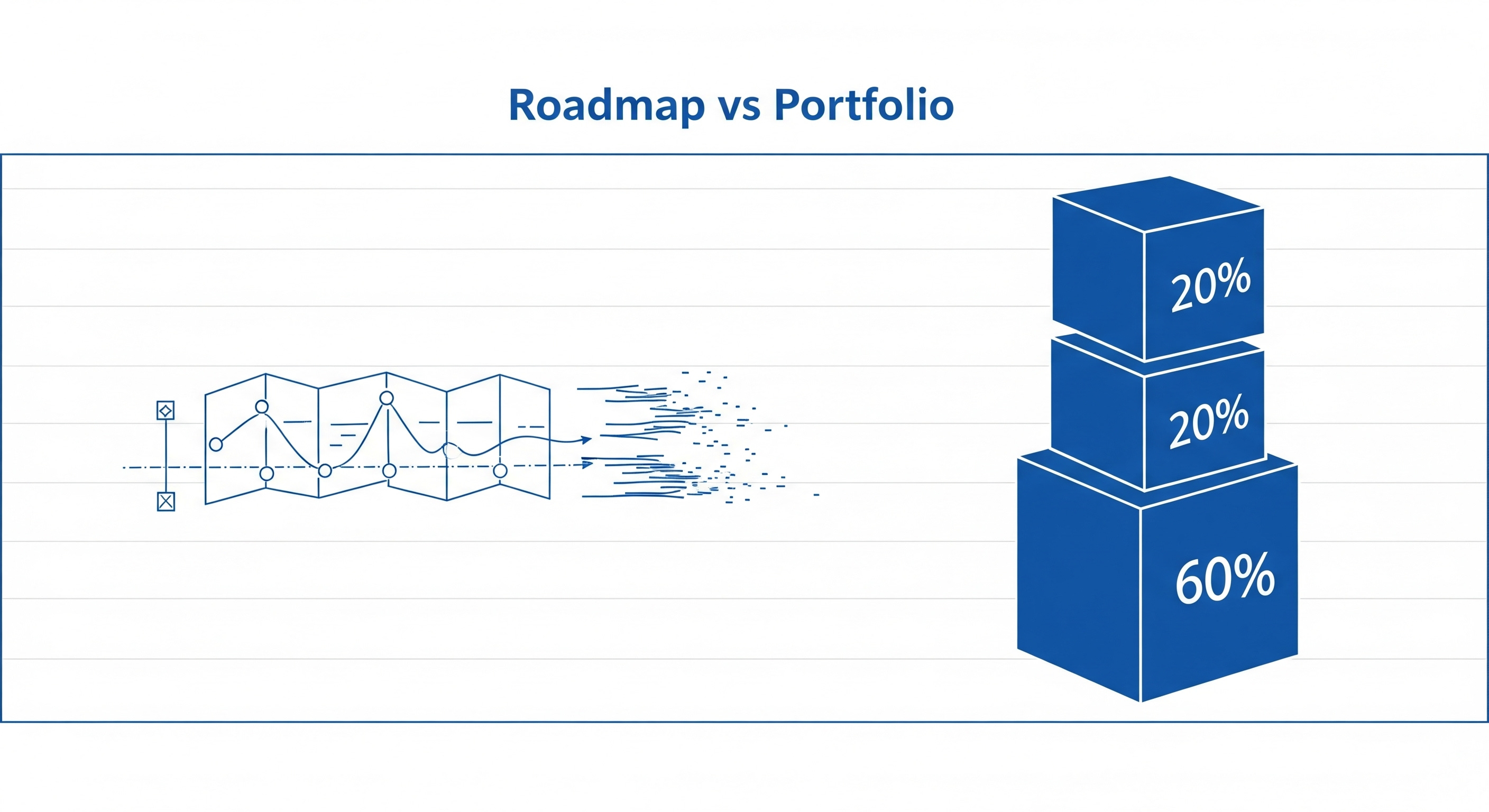
If you want to be strategic (if you want to sit at the table and not just take orders) you have to stop acting like a Construction Manager (scheduling concrete pours) and start acting like an Investment Banker.
This is the shift.
Don’t show me a timeline. Show me a Portfolio.
In Finance, you don’t say, “I will buy Apple stock on Tuesday at 3 PM.” You say, “I am allocating 20% of my portfolio to Tech because it yields high growth.”
We need to treat our capacity the same way.
Instead of promising “Project X in May,” promise an Allocation of Effort.
The Department’s Investment Strategy:
60% - Keep the Lights On (KTLO):
This is non-negotiable. This is Payroll running. This is the bi-annual Workday Release. This is security patching. If we don’t fund this, we go to jail or we don’t get paid.20% - The “Must-Haves” (Compliance/Mandatory):
New tax laws. Union requirements. The stuff we hate doing but have to do.20% - The “Bets” (Innovation/Strategy):
This is where the Roadmap lives. This is the AI Copilot. This is the new module.
The Strategic Flex:
When an executive looks at your PowerPoint and asks, “Why aren’t we doing the AI project in Q1?”, you don’t say, “We’re too busy.” (That sounds tactical/lazy).
You say: “We are currently allocated 60% to KTLO and 20% to Compliance. That leaves us with 20% innovation capacity. If we want to do AI, we have to swap out another ‘Bet’ from the portfolio. Which one do you want to sell?”
Do you hear the difference? You aren’t making excuses. You are managing an investment portfolio. That is strategy.
The Kitchen Table Reality
I tried to explain the concept of “Capacity Planning” to my 11-year-old, Justin, this weekend.
Saturday morning, Justin presented me with his mental Roadmap.
07:00: Wake Up.
07:15: Start a 14-hour 3D print of a helmet.
07:30: Watch YouTube (probably cars getting destroyed in cornfields) while the printer runs.
21:15 Profit (Bonus! +1:15 hour bedtime).
It was a beautiful plan. Clean. Linear. Ambitious.
Then, the Stakeholder (Me) introduced a P1 Incident: “Your room looks like a bomb went off. You cannot see the floor.”
Justin: “But that’s not on the roadmap. The printer is already heating up.”
Me: “The roadmap has changed due to shifting business priorities (Mom is mad).”
Justin: “This is unfair. I have allocated 100% of my capacity to ‘Making Stuff’.”
Me: “Your funding has been cut. You are now allocated 100% to Cleaning. If you execute well, we can discuss a Phase 2 rollout of YouTube later.”
He was furious. But he learned a valuable lesson in Agile Project Management: The plan is nothing; planning is everything.
The Takeaway
Throw away the PowerPoint slide with the hard dates for November. It’s a fairy tale. It makes you look good today, but it sets you up to be a liar tomorrow.
Build a Portfolio. Allocate your capacity. And when the business asks for “more,” make them choose what to trade.
That’s what a Director does.
— Mike
Director HR Tech | Portfolio Manager of the Household
P.S. If anyone knows how to get an 11-year-old to clean his room without invoking a “Total Service Outage” (taking the WiFi router), please submit a ticket to The Department immediately.