


tldr;
Workday announced Sana for ITSM at the Sana AI Summit: agentic automation for onboarding, offboarding, access changes, and everyday IT requests. Built directly on the platform. Early adopters get it in the second half of this year.
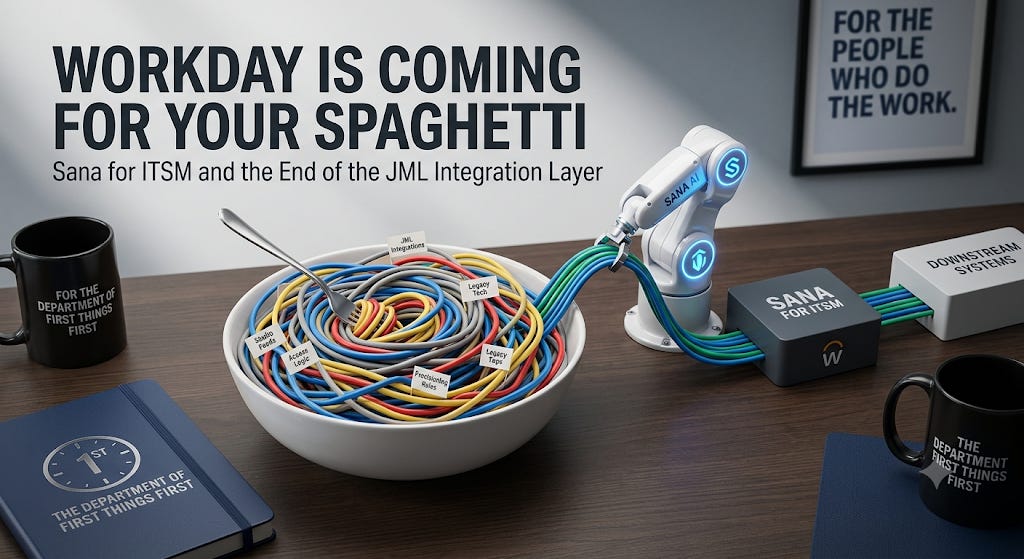
Buried in the announcement: the agent will “automatically trigger access changes when employees join, transfer teams, change roles, or leave.” That’s not a feature. That’s your JML integration layer becoming a product.
This is genuinely good architecture. It’s also a career signal for anyone whose job security rests on being the only person who understands the spaghetti.
The catch: the agent inherits your security model and your data. If those are duct tape, you just gave duct tape an execution engine.
You have roughly six months before early adopter access opens. Use them.
The Announcement
At the Sana AI Summit in New York, Workday introduced Sana for ITSM. The pitch: most IT tickets shouldn’t exist in the first place. Password resets, software installs, access requests, all handled conversationally, inside Workday, routed through the same approval paths and audit trails your org already uses.
It’s Workday’s first formal step into the ITSM market, which puts them in the same ring as ServiceNow. That’s the market story, and the analysts will cover it just fine.
I want to talk about the sentence everyone skimmed past.
Read the Bullet Point Again
From the press release: Sana for ITSM will “automatically trigger access changes when employees join, transfer teams, change roles, or leave the company.”
Join. Transfer. Change roles. Leave.
If you’ve been in this ecosystem longer than a week, you know exactly what that sentence describes. That’s the joiner-mover-leaver layer. The Studio integrations. The provisioning feeds. The termination-triggered deactivation logic someone built in 2019 and nobody has touched since (because the person who built it left, and the documentation is a Visio diagram that lies).
That layer is the connective tissue between your tenant and every downstream system in the building. It’s also (let’s be honest) a meaningful chunk of why the HRIS team is untouchable at budget time. Nobody else understands it. Nobody else wants to.
Workday just announced they’re absorbing it into the platform.
This Is Good Architecture. Say It With Me.
Before anyone reaches for a pitchfork: this is the right design.
The agent lives next to the system that already knows who you are, what role you hold, who approves your access, and what the policy says. It doesn’t need a nightly file feed to learn that Maria transferred to Finance. It’s sitting inside the event. Actions flow through the same approvals and audit logs as human actions, so when the agent provisions access, there’s a trail.
Compare that to the current state at most orgs: an HR event fires, a Studio integration wakes up, a flat file lands somewhere, an identity tool ingests it, and four hours later (if the file didn’t fail) someone has a laptop login. We’ve been running swivel-chair provisioning with extra steps and calling it automation.
The Layer Cake holds. Workday stays the load-bearing wall. The agent is just a much better way to move things through the house.
The Part About You
Here’s the uncomfortable question, and I’m asking it because I like you:
How much of your indispensability is actually just maintenance of the spaghetti?
I wrote last week that indispensability is organizational risk, not job security. This is what that looks like in practice. If your value proposition is “I am the only one who knows how the provisioning feeds work,” Workday just put an expiration date on it. Not tomorrow: Early adopters in R2, GA later, and enterprise reality means your org won’t touch it for a while after that. But the surface area is officially shrinking.
The people who come out ahead here are the ones who understood the why, not just the what. Why does the transfer feed suppress access removal for concurrent-job workers? Why does the term feed wait 24 hours? The agent can execute the what. Somebody still has to own the why (and defend it when the agent does something technically correct and contextually catastrophic).
That somebody should be you. That’s a promotion, not a pink slip. But only if you move first.
Duct Tape With an Execution Engine
Now the First Things First part, because there’s always a First Things First part.
The agent inherits your existing security model, your approval chains, your policy configuration. Workday is selling that as the trust story, and architecturally it is. But read it from the other direction: the agent is only as safe as the model it inherits.
That security group you cloned in a hurry during the acquisition and never rationalized? The agent inherits it. The approval chain that routes to a sup org that hasn’t had a manager since March? Inherited. The role assignments you keep meaning to audit? Inherited (and now attached to something that executes access changes automatically, at machine speed, without getting bored or suspicious).
A messy security model used to fail slowly, one confused human at a time. Give it an execution engine and it fails fast, at scale, with an audit trail politely documenting every mistake.
What I’d Do Before R2
Crawl, walk, run. Same as always.
Crawl: inventory. Every JML integration, every provisioning feed, every downstream system it touches. If you can’t produce the number, you’re not ready to evaluate the agent that replaces them. You can’t orchestrate what you can’t inventory, and you can’t retire it either.
Walk: document the why. Not the field mappings. The decisions. Every weird exception, every deliberate delay, every “we do it this way because of the 2021 incident.” That context is the thing the agent can’t infer and the thing your org will desperately need when it configures one.
Run: audit the security model. Before it becomes the operating system for an agent. This was already the right thing to do. Now it has a deadline.
The Bottom Line
Workday absorbing the JML layer is the platform doing what platforms do: eating the undifferentiated plumbing. It was always going to happen. The only question was whether you’d be the person who governs the thing that replaced the spaghetti (or the person who was the spaghetti).
Pick the first one. You’ve got until 26R2.
— Mike
Director HR Tech | Recovering Spaghetti Chef
P.S. Justin recently lobbied for an automatic feeder for the dogs. It works great: dispenses on schedule, right portions, very impressive. He still got in trouble last week when Toby didn’t get fed, because the feeder jammed and nobody checked it. Turns out automating the task doesn’t automate the accountability. Somebody should put that on a slide at Rising.
The Department of First Things First. For the people who do the work.