


tldr;
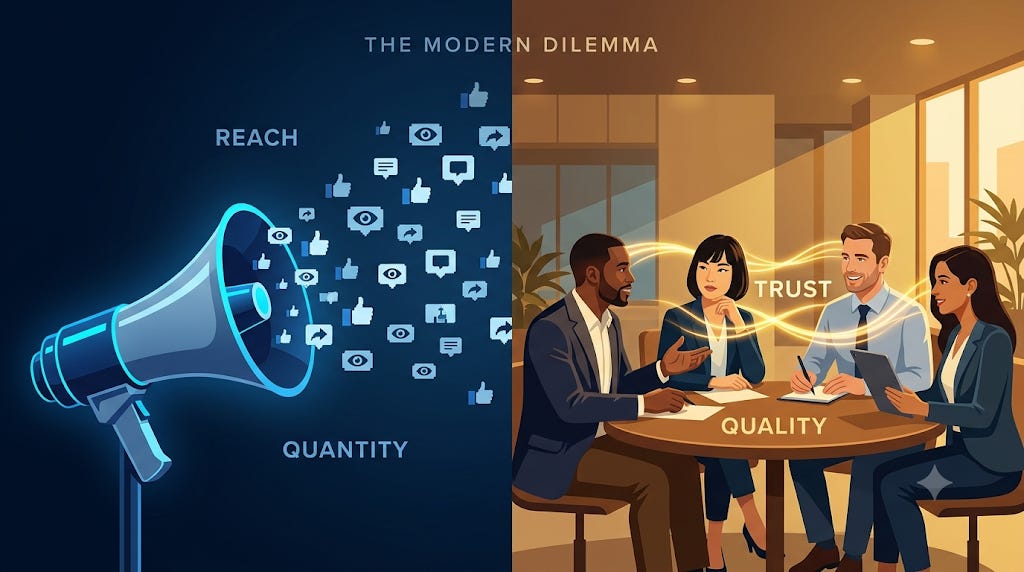
My best-performing post ever reached 71,600 people and converted six subscribers. One user group room of about 170 converted forty-five. Per person, the room outperformed the feed by roughly 3,000x.
Reach was never the scarce resource. Trust is. Feeds manufacture awareness; rooms manufacture trust; only trust converts.
The RUG is not the farm league of this ecosystem. Per person, per minute, it’s the majors.
Three moves, whether you run a room or just stand in one: make every meeting a capture event, give every speaker the recap promise, and trade speakers between rooms.
I’m saying all of this to a room full of RUG leaders at Rising next Monday. Consider this the leaked memo.
On July 6th I posted the best-performing thing I have ever put on LinkedIn.
71,600 impressions. 173 engagements. My follower count jumped. My phone buzzed for two days. By every metric the platform shows you in big friendly numbers, it was the peak of a year of writing.
And that week, my newsletter (the thing I actually care about, the thing all of this allegedly feeds) gained six subscribers.
Six.
Now the other number. Two months earlier I stood in a room at the TOLA regional user group and gave a twenty-minute talk to about 170 practitioners. Forty-five of them subscribed.
Do the math with me, because I resisted doing it for weeks. The feed converted at eight thousandths of one percent. The room converted at roughly one in four. Per person reached, the room outperformed my biggest “viral” moment by a factor of about three thousand.
Three thousand. That is not a rounding disagreement. That’s two different universes pretending to be the same channel.
Reach was never the scarce resource
Here’s what those two numbers finally forced me to understand.
Feeds manufacture awareness. Rooms manufacture trust. And in this ecosystem, only trust converts, because of who we are and what we’ve survived.
Think about who this audience actually is. People who’ve sat through a decade of vendor demos that didn’t survive contact with their tenant. People who can smell a sponsored take from the parking lot. People drowning in analysts and vendors and absolutely starving for operators, for one voice that has personally loaded the EIB and lived with the consequences.
An audience like that does not subscribe because a post crossed their feed at a lucky hour. They subscribe when they’ve decided you’re real. And the deciding happens at human bandwidth: a talk, a hallway question, a conversation where you said the thing they were already thinking and couldn’t say out loud at work.
You can’t scroll your way to that. You have to be in the room.
The farm league fallacy
Which brings me to the thing our ecosystem gets “bass-akwards”.
We treat the conference talk as the big time and the regional user group as the farm league. The Rising Slot has hundreds of seats and production values. The RUG has forty folding chairs, a projector with one dead HDMI port, and someone heroically wrangling a sign-in sheet.
Now run the conversion math on those two rooms. The conference audience forms approximately zero trust with any individual human on that stage; that’s not what conferences are for. The forty people in the folding chairs will remember the speaker by name, connect the next morning, and tell a colleague. Per person, per minute of attention, the RUG is the most valuable stage in the entire Workday ecosystem, and it’s treated like a rec league.
The rooms were never the farm league. The rooms are the majors with bad lighting.
Three moves
So here’s what I’d do about it, whether you run one of these rooms or just stand in them. (Next Monday I get ten minutes in front of the people who run them, at the Community Summit before Rising. This is that talk, a week early, because the people in the folding chairs deserve the memo too.)
Make every meeting a capture event. Attention that isn’t captured within 24 hours evaporates. A QR code on the last slide. A one-page artifact people leave with. A follow-up that arrives while they still remember why they cared. If you speak and there’s no way for a convinced person to stay connected to you, you didn’t give a talk, you gave a performance.
Give every speaker the recap promise. The single best conversion mechanic I know, and it costs nothing: end with “I’m going to write up what this room said, anonymized, and send it out next week. Scan here if you want it.” It works because the audience co-owns the artifact. They’re not subscribing to a newsletter; they’re claiming a conversation they were part of. Room leaders: teach this to every speaker you book, and yours becomes the best gig in the ecosystem.
Trade. Rooms compound when leaders swap rosters. A practitioner who lands in Philly should be on a plane (or a Zoom link) to Dallas the next quarter (as a Philly guy, I can't believe I just said that out loud! Now if the Birds split this year with Dak and the ‘Boys youse can blame me). We are all running the same experiment in isolation, rebuilding the same speaker list from scratch. The moment the rooms start trading, every room gets better, and the operators this audience is starving for get a circuit instead of a one-off.
The part where I ask
If you run a room: your speaker calendar is the most valuable thing you control, and my own calendar is open. Trade with me. Trade with each other. Come find me Monday night and let’s make it concrete.
If you’ve never spoken at one: the stage you think you’re waiting for already exists, it’s twenty minutes from your house, and the person who runs it is perpetually one speaker short. You do not need permission or a keynote. You need a war story and a QR code.
The analysts have the feeds. We have the rooms.
I know which one I’d bet on. I have the spreadsheet.
— Mike
Director HR Tech | Six Subscribers Wiser
P.S. Speaking of capture infrastructure: the tag flies to Vegas next week. Designed, printed, and invoiced (with a brand premium we’ve agreed to stop discussing) by Justin’s 3D Lab. You voted on the design. Every scan is tracked, and the proprietor is aware that the number to beat is six. He has asked me to communicate that he is, quote, “not worried.”
The Department of First Things First. For the people who do the work.