


tldr;
• Workday Candidate Profile lets job seekers save their info once and prefill about 80% of an application at any employer on Workday Recruiting. Good feature. Overdue, honestly.
• The profile exists before the candidate picks an employer. So it doesn't live in your tenant. That likely makes Workday a controller of candidate data, not just your processor.
• Workday hasn't said publicly how retention, deletion, consent, or your DPA handle that. One analyst outlet reported it ships on by default.
• Below: five questions to send your account team before it lands on your career site.
Several Risings ago (after 8 they start running together), I found out the next action button was coming to the candidate grid. GA that day.
So I stopped right there on the floor, configured it, closed the ticket, and waited.
The recruiters found it almost immediately. They loved it. I felt like a hero. (No change request. No steering committee. Just a happy recruiter and a closed ticket.)
That's how I've hunted at Rising ever since. Not for the roadmap. For one thing I can turn on this week that saves somebody's day.
This year I thought I'd found it again.
At this year's keynote, Gerrit Kazmaier said it out loud: People roast the Workday candidate login. Constantly.
The room laughed. Then the room clapped. (Seventeen thousand people, a healthy percentage of whom have reset a candidate password on someone else's behalf.)
Then he showed Workday Candidate Profile. Save your info once. Reuse it at any company that hires through Workday. Email, one-time code, done. Roughly 80% of the application filled in before you type a word.
I clapped too. My first reaction: roll this out as soon as humanly possible. That's my next action button.
My second reaction was a question. And the longer I hung with it, the less I wanted to be first in line.
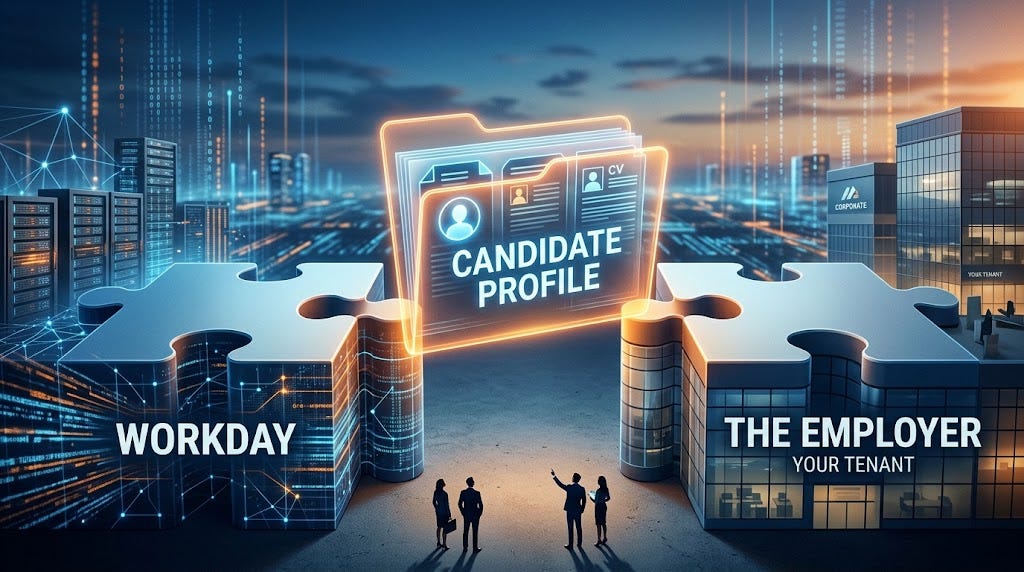
Where does the profile live before the candidate picks you?
Nobody's tenant
The candidate signs in with an email and a one-time code. No employer account. No tenant login. They build the profile, then they choose where to apply.
Which means at the moment it's created, the profile doesn't belong to any customer. It's not in your tenant. It's not in mine.
It's Workday's.
That sounds like a nitpick. It isn't. For as long as Workday Recruiting has existed, its privacy model has rested on one line: your company owns the candidate relationship, and Workday holds the data on your behalf.
Candidate Profile steps over that line. Politely. With great UX. But it steps over it.
The line you've been standing on
Workday's own privacy statement draws it clearly. When you use a Workday app your employer provides, the employer is the controller. Workday is the processor, working on the employer's instructions.
Every applicant privacy notice you've written assumes that. Every DPA your legal team negotiated assumes that. Your retention calendar assumes that.
A profile a job seeker creates directly, before any employer is in the picture, doesn't fit that model. Somebody decides why and how that data gets processed before it ever reaches you. That somebody is a controller. And it isn't you.
Has Workday said so? No. Has Workday said otherwise? Also no. The press release covers prefill, speed, and abandonment rates. Data custody doesn't come up. (Read it. It's not in there.)
I'm not the only one who noticed. HR Tech Edge pointed out that the announcement skips most of the retention, deletion, and privacy-management details.
Two copies, two clocks
Once the candidate applies, you get a copy. That copy is yours. Your retention rules, your purge jobs, your privacy process.
The profile stays where it was.
So picture the request every EU recruiting team will eventually get: delete everything you have on me. You run your purge. It works. Your copy is gone.
The profile isn't. You never owned it, so you can't delete it.
I think that's exactly how it should work. When an employer deletes your application, your LinkedIn profile doesn't vanish either. But your process, your notice, and your answer to that candidate now need to know there are two doors. Today they assume one.
Defaults someone else picked
Constellation Research reported that Candidate Profile is on by default and included in Workday Recruiting subscriptions, with GA in December 2026. Workday's own release says early calendar 2027. The date gap is probably just a slip. "On by default" is the part I'd confirm.
Because on by default means a sign-in option governed by someone else's privacy terms shows up on your career site, unless someone on your team does something about it.
Which is the irony. I came home wanting to turn it on. If Constellation is right, I won't have to.
Two more things from Rising week:
• The keynote said the profile is also reachable through ChatGPT. That's another party in the chain.
• In the Talent Acquisition breakout, unified consent management across the TA suite was on the roadmap. Marked "Future." Candidate Profile ships before it does. And that slide was under safe harbor, so the consent piece is a direction, not a commitment. The profile has a ship date. The consent framework has a disclaimer.
None of that is scandalous. It's sequencing. But sequencing is exactly where practitioners get burned, because the feature ships on a date and the governance ships "later."
It's a network, not a form
Read Workday's blog post on Candidate Profile and one line jumps out. Over time, the profile can help build a "deeper, more trusted picture" of a candidate's experience and career history.
Prefill is the feature. The picture is the strategy.
A profile that spans thousands of employers, gets verified, and gets richer with every application is a candidate graph. Workday has never had one of those. You know who has? LinkedIn.
I'm not saying that's sinister. I'm saying it's a much bigger product than autofill, and your governance should be sized for the bigger thing.
If you read my Silver Lake piece, you know the Monday action I keep coming back to: inventory what you own versus what you rent. Your candidate data just picked up a new line on that inventory.
In fairness
Candidate login hell is real. Workday cites a 60% application abandonment rate from length and friction (I believe it's higher), and anyone who has supported a career site has worked the "I can't log in" ticket more times than they'd like to admit. Fixing that is good for candidates, good for recruiters, and good for the reputation of everyone who configures this stuff.
The design is restrained in the right places, too. It doesn't rank, recommend, or reject anyone. Candidates choose what each employer sees. And a verified, reusable identity is a real brick in the wall against the bot-vs-bot fraud mess. (A profile that persists is a lot harder to fake than an application that doesn't.)
And Workday's privacy people are good at this. I'd bet the controller question has an answer in a contract somewhere.
The problem isn't that the answer doesn't exist. It's that you need it before your career site changes, not after.
What to do by Next Monday
Five questions. Send them to your account team and copy your privacy office.
1. Who is the controller of Candidate Profile data, before and after a candidate applies?
2. Is it on by default? Can we turn it off, and can we turn it off by region?
3. When we purge a candidate, what happens to the profile? Who handles the deletion request?
4. What changes in our DPA, if anything? Is an addendum coming?
5. When a candidate uses the profile through ChatGPT, who's the processor on that path?
Next, the internal homework. Flag your applicant privacy notice for review. Add a row to the retention calendar. Decide who owns the toggle before Workday decides for you.
I still want this feature, the earlier the better. I'm just not flipping it on until those five answers come back.
Some years ago, the hero move was configuring something on the floor before lunch. This year, it's an email.
Your candidates were yours because nobody else could reach them.
That was never a policy. It was the architecture.
And the architecture just changed.
— Mike
Director HR Technology | (Allegedly) Not a Data Controller
P.S. — I asked this in a LinkedIn comment over the weekend. It got four likes and a "great point!" Which, in LinkedIn economics, is a standing ovation. If you're on an Global, EU, or UK recruiting team and your privacy office is already asking about this, hit reply. I want to know what they're asking.